How Much Should an MVP Cost in 2026? Start With Scope
Published prices for a simple MVP run from $8,000 to $60,000, because the word covers very different products. Here is what agencies ask, the one rule that decides what goes in, and a tool to build your own first version.
Most founders ask what an MVP costs when the better question is what it should contain. Two quotes for "an MVP" can sit far apart and both be fair, because they describe different products. So this guide is about the decision that sets your budget: what goes in the first version, what waits, and what you cut. For how a project's money splits across phases, see our SaaS development cost guide. Here we stay on scope.
How Much Does an MVP Cost in 2026?
There is no neutral price list. What exists is what agencies publish, and every figure below comes from a company selling the work, ours included. Read them as asking prices.
Three things explain most of that spread. The first is scope: "simple" means three to five screens in one guide and a dashboard with one or two functions in another. The second is location: AddWeb says a US in-house or US agency build of the same product typically costs two to three times more than its offshore or hybrid numbers. The third is what is included. Our range covers discovery, architecture, development, CI/CD, staging and production, and 30 days of post-launch support over a 12-week plan. Ask every vendor for the same list.
One publisher, Hapy Co, says there is no defensible universal price for a standard MVP, and we agree. A range is only useful once it is attached to a scope. If you are unsure whether to pay anyone yet, read what it costs to build an app with AI. A $25 builder plan can answer some questions before any of these prices apply.
What an MVP Is For
An MVP is a test that happens to be software. In his Y Combinator Startup School lecture, Michael Seibel told founders: "You should be able to build it fast in weeks, not months." His method is to set a date, list what fits, and cut what clearly isn't important when the date slips. He treats heavy MVPs as rare, mainly in heavily regulated or hard-tech fields.
CB Insights calls running out of capital the final cause of death, rarely the root problem. Put that together with the fit figure and you have the case for a small first version. Money spent on features nobody tested is money you no longer have when you learn what people want. The sample is venture-backed companies in one period, so treat it as a pattern and keep your own runway in mind.
What Goes in an MVP: One Rule
Write your product's promise in one sentence: who it helps, and with what job. Then test every feature against this rule.
- Must-have: the core job fails without it, or you cannot legally or safely operate without it.
- Wait: it makes the job nicer, faster or easier to run. Add it when real users ask or when a manual workaround hurts.
- Cut: it serves users, markets or scale you do not have yet.
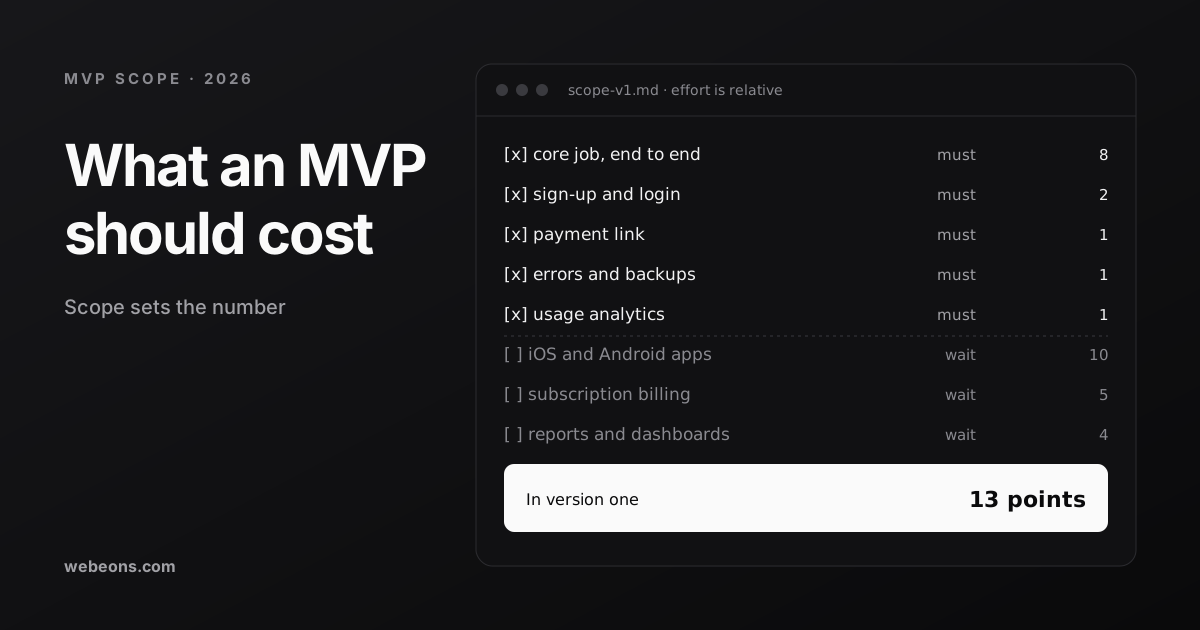
Safety features pass the rule. Error tracking and backups are small and they stay in. So does usage analytics, because you are paying to learn, and a test with no measurements teaches you nothing.
Build Your MVP Scope
Answer the five questions, then tick what you have in mind. The tool applies the rule to each feature and shows relative effort. The sizes and the 20-point line are our judgment, drawn from how much work these features tend to take on a typical web product. They are not hours or dollars, and your product may differ. The default selection is a typical wish list: reasonable on paper and too big for a first version.
A Worked Example: From 37 Points to 19
Take the default in the tool: a paid product for individuals, with no sensitive data, no phone requirement and no AI at its core. The wish list has ten items and comes to 37 points, nearly double our line.
The rule adds one thing first. Usage analytics is missing, and it costs a single point, so the list rises to 38. Then the cuts begin, largest first among the features that can wait. The iOS and Android apps go, at 10 points. Full subscription billing goes, at 5, and a payment link stays in its place. Reports and dashboards go, at 4. That lands on 19 points with admin screens, search and email notifications still in the first version.
Nothing on that cut list was a bad idea. Each one moved to a later version, where real usage can show whether it earns its place. If you change one answer, the result changes too. Say the product now sells to teams: roles become a must-have, the list grows by 4 points, and admin screens, the next-largest item that can wait, come out to make room. That is the real conversation to have before anyone quotes.
What to Cut First
Most of the savings come from the same few features. Each has a cheaper stand-in that still lets you learn. That is the trade: more manual work for you, less software to pay for.
| You want | Start with | Build the real thing when |
|---|---|---|
| iOS and Android apps | A responsive web app | The job needs the camera, location or push |
| Full subscription billing | A payment link | Plan changes eat your week |
| Admin screens | The database console, used carefully | Someone non-technical runs daily operations |
| Reports and dashboards | A weekly export to a spreadsheet | Customers ask to see the numbers themselves |
| Team roles | One shared account per customer | A paying customer needs separate access |
| Automated emails | Send them by hand | You send the same one every day |
| Integrations | A CSV import | Several customers ask for the same one |
Native apps are the biggest line on most lists. If you do need one, our framework comparison covers how to choose, and our guide to multi-tenant architecture explains why team accounts deserve thought even if you delay them.
Scoping Decisions From Our Own Products
We scope our own products with the same rule, and the trade-offs are real. Four examples from what we have built.
- Ship one surface, keep the door open. AskOrac, our AI chatbot platform, runs only on the website widget today. We pulled limits and escalation out of the chat route into a channel-agnostic engine, so new channels become adapters instead of rebuilds. We stopped at the first phase on purpose, because rewriting the streaming path too would have put the core revenue path at risk.
- Buy the part that is not your product. In Shelf Inn, our home library app for iOS and Android, our own camera stack proved fragile. We moved to a proven library and spent the effort on the room itself. We now live with that library's behavior, which is a fair price.
- State a limit instead of solving it. Shelf Inn's phones render up to 800 books and say so plainly when a library is larger. A clear limit is a scoping decision that users can accept.
- Finished does not mean on. BlurbBio, our AI writing platform, keeps gold-standard answer keys for test manuscripts, and a check goes live only when it passes. Some finished features stay off. If you have AI in your MVP, plan for the same discipline, because a bad AI feature can cost you more trust than a missing one.
What You Should Not Cut
Small scope does not mean careless work. Keep backups, error tracking, access checks on the server, and a way for users to reach you. If you hold personal data, keep the controls that protect it. Our production checklist lists them for AI-built apps, and they apply to any first version.
Budget for the period after launch as well. Teamseven, an agency, advises setting aside 15% to 20% beyond the build for the first 90 days. Our own range includes 30 days of support. Either way, keep money back: your first real users will change your plan, and the point of an MVP is to pay for that change.
How you contract matters too. A fixed price rewards a tight scope, while hourly work suits one that is still moving. Our guide to billing models and our buyer's guide cover both.
Where This Is Heading
- A working app proves less than it used to. Sensor Tower estimates, reported through 9to5Mac on July 20, 2026, put new App Store apps at about 560,000 in the first half of 2026, roughly double, with downloads up 2%. Your MVP's job is more clearly to find demand, since shipping is now common.
- Copies face a higher bar. In June 2026, Apple's guideline 4.3(b) gained the line "Don't submit apps that are indistinguishable from what's already widely available." A mobile MVP that is a thin copy of an existing app risks rejection.
- The first test is getting cheaper. With AI builder plans from about $25 a month as of October 2026, more founders can test an idea before paying for a build. We expect paid MVPs to start from stronger evidence, and that makes this scope work easier.
Decide the Scope, Then Ask for a Price
Write the promise, apply the rule, and take your short list to two or three vendors, so that every quote prices the same thing. If you want help with the list, send us your feature list and we will tell you what we would cut, including when the answer is to test with a cheaper tool first. Our MVP development page sets out what our $40,000 to $80,000 range includes and how the 12 weeks run.
Sources (11)
Common questions
How much does an MVP app cost?
Agencies publish simple MVPs from $8,000 to $60,000, and more complex ones from about $45,000 to $100,000 or more. These are asking prices, and they depend on scope, team location and what is included. Our listed MVP range is $40,000 to $80,000.
How much should an MVP cost?
As little as it takes to test one promise with real users. Decide the scope first, then ask for prices. Hapy Co, which sells MVP work, says there is no defensible universal price for a standard MVP, and we agree.
What features should an MVP include?
The one core job, plus anything without which that job fails or you cannot legally or safely operate. Keep backups, error tracking and basic usage analytics. Everything else waits or gets cut.
Should an MVP be a mobile app?
Only if the core job needs a phone, such as the camera, location or push notifications. Otherwise start with a responsive web app, since native apps are usually the largest item on a feature list.
How long does an MVP take to build?
Michael Seibel of Y Combinator advises building in weeks, not months. Our own MVP process runs 12 weeks, and it includes discovery, infrastructure, feature sprints and launch. Agencies publish 4 to 18 weeks depending on scope.
Have a feature list that keeps growing?
Send it to us with your one-sentence promise. We'll mark what is a must-have, what can wait and what to cut, and tell you what the result should cost.