How to Hire Developers From India: US, UK and Australia Guide
Four hiring models, survey pay data with its limits, time zones, the contract clause that catches foreign companies, and how to vet people across the distance.
Hiring developers in India from the US, UK or Australia is normal, legal and well supported, and it fails for predictable reasons: a contract written for another country, a late shift nobody agreed to, or nobody on your side able to review the code. Salary is the easy part. This guide covers what to pay, which legal route to use, how to handle the time difference, and how to vet people.
Our interest, stated upfront: Webeons sells a dedicated engineer service, and our working hours are GMT+5:30. So one of the four options below is ours. We have tried to make the case for the other three fairly, and you should test ours against them. For choosing between software firms in general, use our guide to choosing a development company. This article is about India specifically.
Four Ways to Hire Developers in India
The models differ on one question above all: who is legally responsible for the person, and for the work.
| Direct contractor | Employer of record | Agency | Dedicated engineer | |
|---|---|---|---|---|
| Who employs them | Nobody, they are self-employed | The provider, on your behalf | The agency | The provider |
| Who directs the work | You, against a scope | You, as their manager | The agency | You, with provider oversight |
| Published fees | $29–$49 a month for a contract platform, optional | From $599 a month per employee | Quote | Quote |
| Best length | Weeks to about a year | A year or longer | A defined project | Three months and up |
| Main risk | Misclassification and weak IP terms | High fee on a modest salary | You do not choose the people | Margin you cannot see |
Direct contractor. It is the cheapest and fastest route, and it puts all the risk on your paperwork. If the person works only for you, full-time, under your direction, for years, a contract that calls them independent may not hold up. Platforms sell cover for this: Deel and Remote both list a Contractor of Record product at $325 a month, where the provider holds the contract or the liability.
Employer of record. The provider employs the person in India and you direct their work. Deel and Remote both start at $599 per employee per month. Remote lists that on annual contracts, and Deel describes month-to-month terms. Check the current terms for India before you sign, since these are starting prices and employment costs are charged separately.
Agency. You buy an outcome. It suits a defined project when you have nobody to run the work. You give up choosing the individuals, so ask by name who will write the code and how much of their week is yours.
Dedicated engineer. A provider supplies one named person who works in your team, and takes on employment, replacement and some oversight. It sits between a contractor and an agency. The cost is a margin you usually cannot see, so ask what the engineer is paid or at least what the oversight actually includes.
A fifth route, your own subsidiary, makes sense at a larger scale. Nasscom and Zinnov counted 2,117 global capability centers in India as of March 2026, employing about 2.36 million people. That is a different project from hiring your first two developers.
What Developers in India Actually Earn
The best open dataset we found is Stack Overflow's 2025 Developer Survey, which reports medians by role and country in US dollars. India had 1,093 responses on that chart. PayScale, updated October 10, 2026, gives a separate check: a median base salary of ₹712,000 across 1,799 profiles, with the 90th percentile near ₹2 million.
Do not budget from these medians. They tell you the market's shape, not the price of the person you want. The survey covers every experience level, and neither it nor PayScale gives a reliable figure for an experienced senior who works well with overseas teams. Look at the spread: PayScale's 90th percentile is close to three times its median. Get real numbers by asking candidates or providers, and treat anyone offering a senior at the median with suspicion.
The pay gap is also not your saving. Once you add management time, fees, overlap and the cost of a bad hire, the difference shrinks. By how much depends on your situation, and we have no sourced number for it, so we will not give you one.
Compare the Models for Your Hire
This tool uses the survey median as a starting salary, the published fees above, and your own quotes. It does not guess what an agency charges, because we found no neutral data. Move the salary to a real offer, and add any quotes you have. The suggested model follows a short rule: three months or a junior points to a managed option, two years points to employment, and a senior for a defined year points to a direct contract.
Time Zones From the US, UK and Australia
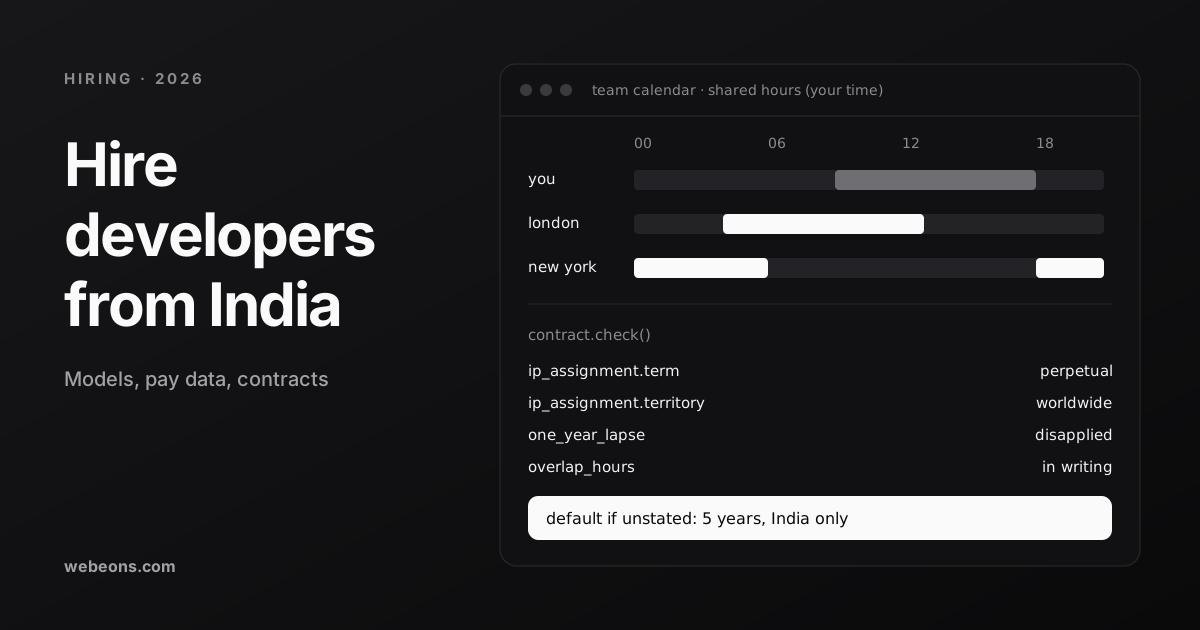
India runs on UTC+5:30 with no daylight saving, so the gap depends on your clocks. US clocks go back on November 1, 2026. From November 1, 2026, India is 10.5 hours ahead of New York, 13.5 ahead of San Francisco and 5.5 ahead of London. Sydney sits on the other side: New South Wales is on daylight time until April 4, 2027, which puts Sydney 5.5 hours ahead of India.
London and Sydney are the easy cases, with a normal Indian day overlapping your own. The US West Coast is the hard one. A few hours of overlap there means either your early morning or their night.
Think hard before you ask for a permanently late shift. In our judgment it holds for a few months and then wears people down. We would ask for two or three shared hours, a written update at the end of each day, and clear rules for what waits until morning. Our working hours are GMT+5:30, so ask us the same question: which hours, for how long, and what happens in an outage.
Contracts: What Must Be in Writing
Use a lawyer who knows India for this. We are engineers, and this section tells you what to ask, not what the answer is.
Who owns the code. India's Copyright Act is specific, and contracts copied from another country can miss it. Section 19 says an assignment must be in writing and signed. It must identify the work and state the rights, duration and territory. If no period is stated, it is deemed to be five years. If no territory is stated, it is presumed to extend within India. And if the rights are not exercised within one year, the assignment lapses unless the contract says otherwise. So a one-line "all IP belongs to the client" is a real risk. Ask for a perpetual, worldwide assignment that disapplies the one-year lapse.
Employment status. Write down whether this is a contractor or an employee, then make the daily reality match. Fixed hours, your equipment, your manager and exclusive full-time work all point toward employment.
Tax paperwork. In the US, Form W-8BEN documents foreign individuals, and foreign entities use W-8BEN-E. Whether you need one for work done entirely outside the US is a question for your accountant, as is anything your own country requires.
Everything else. Confidentiality, access to your repositories and accounts, what happens to data on their machines, notice periods on both sides, exclusivity, and a governing law you can actually enforce.
How to Vet Developers in India
Most vetting advice applies anywhere, and our company guide covers it, including how to run a small paid test. Four checks matter more when you hire across this distance.
- Test written communication. With few shared hours, the daily update is the job. Ask for a written plan before any code.
- Pay for a real task of one or two weeks. It shows more than a live puzzle, and it tests how they ask questions when you are asleep.
- Interview the person who will do the work. With an agency or provider, get the name in the contract, and agree what happens if they are moved.
- Check notice and other commitments. Ask when they can really start, and whether they hold another job.
The risks are real, and they are not unique to India. Good people get other offers, particularly as global companies expand there. Public holidays differ from yours. Currency moves, and you need to agree who carries that. Layers of subcontracting can hide who is doing the work. All of this is manageable if you plan for it.
Sometimes you should not do this at all. If nobody on your side can read the code, a remote hire is not the fix. Start with a firm that owns the outcome, or read our comparison of agency and in-house teams. Keep your first technical lead close, too, if you are still working out what the product is.
Where This Is Heading
Four dated changes affect this decision.
- India's labour law was rewritten. The government brought the four Labour Codes into effect on November 21, 2025. Fixed-term employees now qualify for gratuity after one year, and a 50% rule changes how wages are calculated for statutory purposes. Ask your employer of record how this changes your costs.
- The provident fund ceiling rose. Government releases put the wage ceiling for mandatory coverage at ₹25,000 a month from September 17, 2026, up from ₹15,000. The employer's contribution is 12% of wages.
- US visa policy remains unsettled. As of October 7, 2026, the University of Colorado Boulder's tracker said the $100,000 H-1B fee was not being collected while appeals continue, although a proclamation extends it through September 21, 2027. Do not build a hiring plan on either outcome.
- Competition for seniors is local. Global capability centers already employ about 2.36 million people in India. Our reading is that this keeps pressure on senior pay. That part is our inference, not a measured result.
What We Would Do First
- Decide who will manage this person day to day. If the answer is nobody, stop here.
- Choose the shared hours you truly need, and write them down.
- Run the comparer with a real offer and at least two quotes.
- Have a lawyer review the IP assignment before anyone sees your code.
- Start with a paid task, then a three-month trial period.
If a managed option fits, look at our dedicated engineer service and compare it with an employer of record on the same salary. If you are weighing a whole team, our note on fixed price and hourly billing covers how to pay for it. Or tell us the role and your time zone, and we will tell you which route we would take, even if it is not ours.
Sources (14)
Common questions
How much do developers in India earn?
In Stack Overflow's 2025 survey, developers in India reported medians of $10,462 for mobile, $13,949 for full-stack and $22,086 for back-end roles. PayScale shows a median of ₹712,000 in October 2026. Both mix experience levels, so a strong senior costs much more.
What is the best way to hire a developer in India from the US?
It depends on length and who manages the work. A direct contractor can suit a defined period with a senior person, an employer of record suits long-term employment, and an agency or dedicated engineer suits teams that need oversight supplied.
How much does an employer of record cost in India?
Deel and Remote both list employer of record service from $599 per employee per month, read October 31, 2026. Salary and statutory employment costs come on top, so ask for an India-specific quote.
Who owns code written by a contractor in India?
Get a signed written assignment. Under Section 19 of India's Copyright Act, an assignment with no stated term is deemed to last five years, and one with no stated territory is presumed to cover India. Have a lawyer review it.
How many hours overlap with India from New York or London?
From November 1, 2026, India is 10.5 hours ahead of New York and 5.5 ahead of London. A normal Indian day overlaps well with London, while New York needs a shifted day or an early start to share a few hours.
Get a straight answer on your hire
Tell us the role, your time zone and how long you need the person. We'll say which route we would take, including when it isn't our dedicated engineer service.