Fixed-Price vs Hourly: Why We Stopped Billing by the Hour
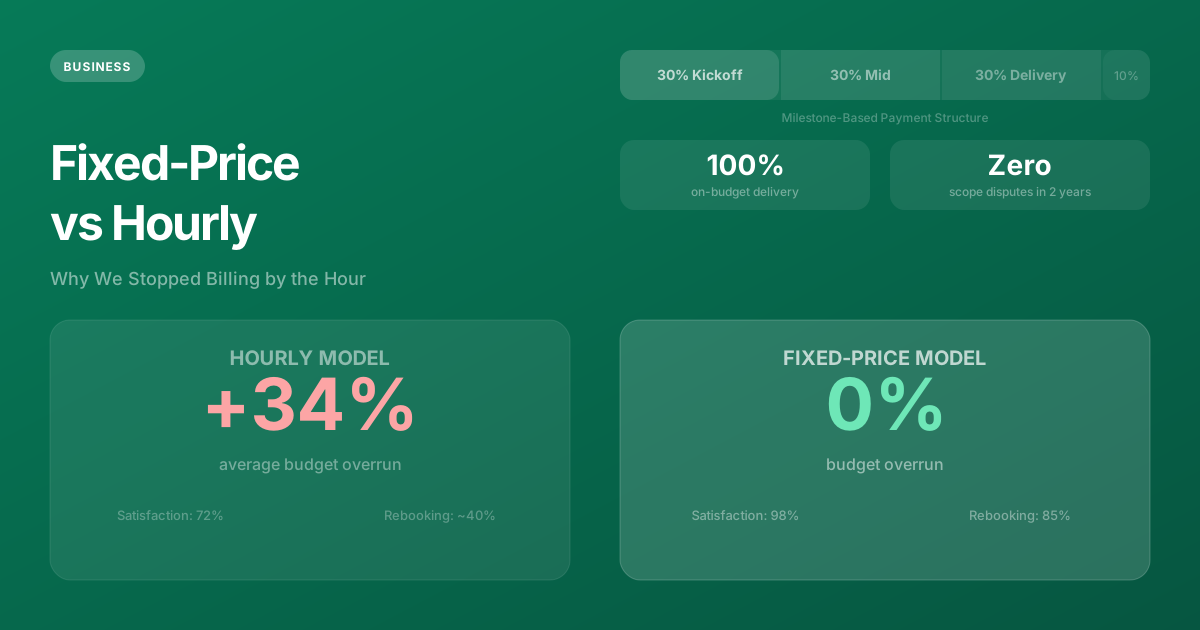
Early in our journey, we billed by the hour like every other agency. It seemed logical — track time, multiply by rate, send invoice. Simple. Then we started tracking outcomes instead of hours, and the results were damning: hourly projects averaged 34% over budget, took 40% longer than estimated, and produced measurably lower client satisfaction scores. We switched to fixed-price engagements in 2024 and haven't looked back.
This isn't a philosophical argument about billing models. It's a data-driven case for why fixed-price produces better software, happier clients, and more sustainable agency economics.
The Structural Problem with Hourly Billing
Hourly billing has a fundamental incentive misalignment that no amount of good intentions, transparent time tracking, or ethical billing practices can fix: the agency profits when projects take longer.
Even with the most honest, well-intentioned team, hourly billing creates subtle behavioral shifts. A developer facing a choice between a quick solution and an elaborate one unconsciously leans toward complexity — not out of malice, but because the billing model doesn't reward efficiency. Why solve a problem in two hours when the budget allows eight? Why automate a process when manual work bills more hours?
The client's incentive is equally misaligned, but in the opposite direction. They want to minimize hours, which means cutting scope, skipping testing, pushing back on necessary refactoring, and pressuring the team to ship faster than quality allows. "Can you skip the automated tests to save hours?" is a question we heard regularly in our hourly billing days. The answer should always be no — but when the client is paying by the hour and feels the budget pressure, the conversation becomes adversarial.
The result is a toxic dynamic: the agency is incentivized to do more, the client is incentivized to accept less, and neither is incentivized to focus on what actually matters — building the best product within the agreed scope.
How Fixed-Price Changes Everything
With fixed-price, the incentives flip — and suddenly both sides want the same thing.
For the agency: we profit by being efficient. Every hour we save through better tooling, reusable components, and smart architectural decisions is margin we keep. This means we invest heavily in our component library, our CI/CD pipeline, our deployment automation, and our project templates — because these investments directly improve our bottom line while also delivering better products faster.
For the client: the price is locked before the first line of code is written. No surprise invoices at the end of the month. No "we went over by 40 hours" emails. No scope creep conversations that feel like hostage negotiations. The price is the price. If the project takes us longer than estimated, that's our problem — not the client's budget overrun.
This alignment transforms the relationship from transactional to collaborative. Instead of monitoring hours, we're collaborating on outcomes. Instead of debating whether a feature is "in scope" to avoid billing disputes, we're making product decisions together because the scope was agreed upon upfront.
The Scoping Process That Makes Fixed-Price Possible
The most common objection to fixed-price is "but what if the scope changes?" This concern is valid — and it's exactly why we invest heavily in discovery and scoping before quoting a price. Fixed-price only works when the scope is clear, detailed, and mutually agreed upon.
The Technical Brief
Every project starts with a discovery phase (typically 3-5 days) that produces a comprehensive technical brief. This document includes:
- Feature-by-feature breakdown with complexity estimates and acceptance criteria
- Technical architecture document — database schema, API design, infrastructure decisions, third-party integrations
- Wireframes for every unique screen and user flow
- Explicit exclusions — what is NOT included, stated clearly to prevent misunderstandings
- Assumptions — decisions we're making based on current understanding, flagged for validation
- Delivery timeline with milestones and demo dates
- Risk register — potential complications and our mitigation strategies
The client reviews and approves this brief before we write a single line of production code. This approval is the foundation of the fixed-price agreement — we're committing to deliver exactly what's described, at exactly the quoted price, by the agreed date.
Handling Scope Changes
Scope changes are inevitable — markets shift, user feedback reveals new priorities, stakeholders have new ideas. We don't resist changes; we manage them through a clear process:
- Client requests a change or addition
- We estimate the cost and timeline impact within 48 hours
- Client reviews the change order — which includes the additional cost, the timeline impact, and any dependencies
- Client approves or declines — no pressure, no judgment
- If approved, the change order is added to the project scope and the price adjusts accordingly
In practice, about 15% of our projects require change orders. The average change order is 8-12% of the original budget. Compare that to hourly projects, where unmanaged scope creep averages 30-50% above the original estimate (Standish Group). The change order process isn't bureaucracy — it's a mechanism that keeps both sides honest and informed.
The Data: Fixed-Price vs Hourly Outcomes
After two years of exclusively fixed-price projects, we have enough data to compare directly against our historical hourly engagements and industry benchmarks:
Beyond budget adherence, fixed-price projects show improvements across every metric we track:
- Client satisfaction: 98% vs 72% industry average for hourly engagements
- Delivery timeline: 12% shorter on average — because efficiency is profitable for us
- Rebooking rate: 85% of fixed-price clients return for additional projects — compared to industry average of approximately 40% for hourly engagements
- Scope disputes: Zero formal disputes in two years — because the scope was agreed upon before work began
Milestone-Based Payment Structure
Fixed-price doesn't mean "pay everything upfront." We use milestone-based payments that align cash flow with deliverables:
- 30% at project kickoff — covers discovery, architecture, and initial setup
- 30% at mid-project milestone — core features are functional and demo-able
- 30% at delivery — all features complete, tested, and deployed
- 10% after 30-day support period — post-launch bugs fixed, handover complete
Each payment is triggered by a concrete, verifiable deliverable — not a date on the calendar. If we haven't delivered the mid-project milestone, we haven't earned the mid-project payment. This structure protects the client from paying for undelivered work and motivates us to hit milestones on schedule.
When Hourly Still Makes Sense
We're not dogmatic. Hourly billing works — and is actually preferable — in specific situations:
- Ongoing maintenance and support — Bug fixes, small feature additions, and performance monitoring don't have a defined "scope." A monthly retainer with hourly tracking makes sense.
- Advisory and consulting engagements — Architecture reviews, code audits, and technical mentoring are inherently time-based.
- Genuinely exploratory R&D — When no one can predict what "done" looks like because the problem itself is undefined, hourly billing with regular check-ins is the honest approach.
For these situations, we offer retainer agreements with monthly hour caps, detailed time reporting, and clear expectations about what the hours will be spent on. But for product development — building something from scratch or adding a major feature — fixed-price is better for everyone.
The Bottom Line
Fixed-price isn't just a billing model — it's a statement about how we believe software should be built. The scope should be clear before development starts. The price should be predictable and fair. The agency should be incentivized to ship efficiently, not to maximize hours. And the client should be able to focus on product decisions, not invoice anxiety.
If your current agency bills by the hour and your projects consistently run over budget, let's talk about a better approach. and your projects consistently run over budget and over time, the billing model might be the root cause — not the team's ability.
Need help with this?
We build exactly what this article describes — production-grade digital products for ambitious companies.
Start a Project →