Agency vs In-House: How to Decide What's Right for Your Product
"Should we hire an agency or build an in-house team?" We get this question from nearly every potential client. It's the right question to ask — and the wrong question to answer with a blanket rule. The honest answer depends on your company's stage, your timeline, what you're building, and how long you'll need engineering resources.
What we can offer is a data-driven framework for making this decision, based on real cost analysis and outcomes from both models. We've been on both sides — we've built products as an agency, and we've helped clients transition from agency-built V1s to in-house teams for V2+. Here's what we've learned.
The True Cost Comparison
Most cost comparisons between agencies and in-house teams look at salary vs. project fees and call it a day. That comparison is misleading because it ignores the fully loaded cost of an in-house hire, which extends far beyond base salary.
The Fully Loaded Cost of In-House
The cost of hiring a single senior full-stack developer in the US market in 2026 breaks down like this:
- Base salary: $150,000 - $200,000
- Benefits (health, dental, vision, 401k): $25,000 - $40,000
- Equipment and software: $5,000 - $10,000
- Recruiting costs: $22,500 - $40,000 (15-20% of first-year salary, one-time)
- Office/remote stipend: $3,000 - $6,000
- Training, conferences, professional development: $3,000 - $5,000
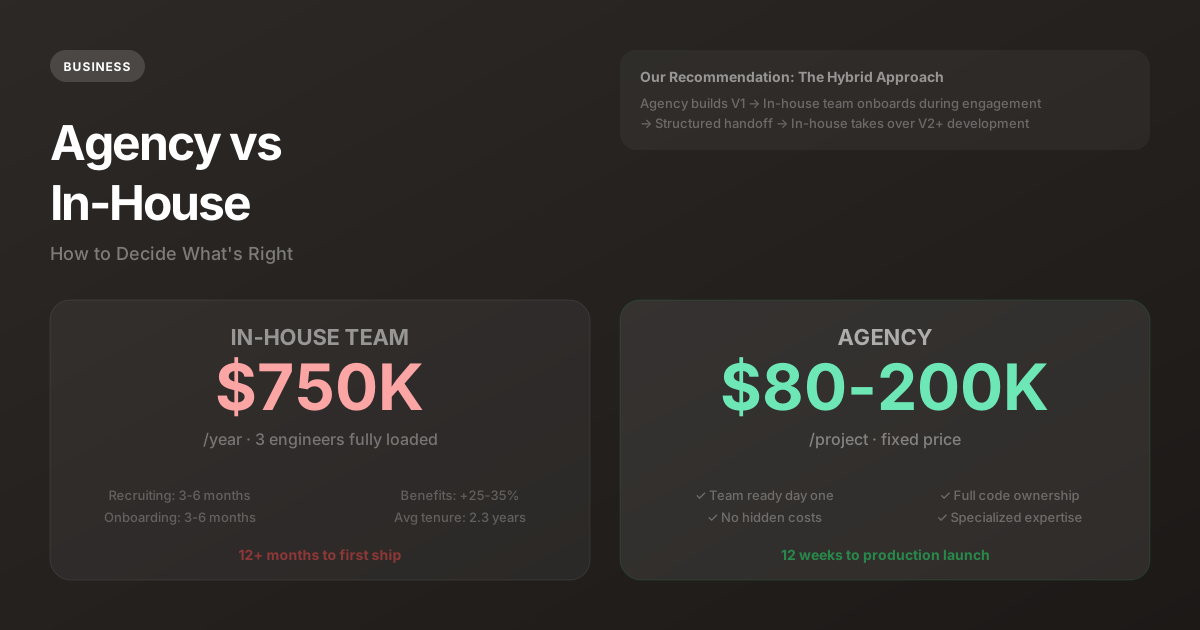
That's approximately $208,000 - $301,000 per year fully loaded — for one developer. A minimum viable product team requires at least three people: a frontend developer, a backend developer, and a designer. At $250,000 average fully loaded cost per person, you're looking at $750,000 per year before writing a single line of code.
And that's assuming you hire successfully on the first try. The average time to fill a senior engineering role is 60-90 days (LinkedIn, 2025). Failed hires — which happen approximately 30% of the time for senior roles — cost an estimated 2-3× the annual salary when you account for lost productivity, re-recruitment, and project delays.
The Agency Cost Model
An agency engagement for a comparable product — let's say a SaaS MVP with authentication, core features, payments, and deployment — typically costs $80,000 - $200,000 as a fixed-price project. That includes design, development, testing, deployment, and a support period. The engagement lasts 10-16 weeks, and when it's done, you own the code outright.
The math is straightforward: for the annual cost of an in-house team ($750K), you could fund 3-5 complete agency projects. Or you could fund one agency project ($100K) and use the remaining $650K to hire your first two in-house engineers to maintain and grow what the agency built.
When to Hire an Agency
Agencies deliver the most value in these specific scenarios:
You Need to Ship Fast
An agency team is pre-assembled, aligned, and productive from day one. There's no recruiting pipeline, no onboarding period, no team-building phase. A 12-week agency engagement delivers working, deployed software. A 12-week hiring process delivers a signed offer letter — with the new hire's first productive output still months away.
If you have a market window, a funding milestone, or a competitive threat that requires a working product in the next quarter, an agency is the only realistic option.
You Need Specialized Skills Temporarily
Building a mobile app, implementing AI features, setting up Kubernetes infrastructure, or redesigning your product's UX requires expertise your generalist in-house team may not have. An agency brings that specialized expertise for the duration of the project without a permanent salary commitment. When the project ends, so does the cost — you're not carrying a Kubernetes expert on payroll for the next three years because you needed one for three months.
You're Validating a Product Idea
Before committing $750K per year to an in-house team, spend $80-150K to build an MVP with an agency. Launch it. Get user feedback. Measure traction. If the product finds market fit, hire in-house to maintain and grow it — now you're hiring with a clear product vision and an existing codebase for candidates to evaluate. If the product doesn't find market fit, you've spent $100K learning that lesson instead of $750K.
You Have a Defined Scope
Fixed-scope, fixed-timeline projects are ideal for agencies. The engagement has a clear start and end, deliverables are defined and measurable, and costs are predictable. Agencies excel at executing against a clear spec — they've done it dozens or hundreds of times before.
When to Build In-House
In-house teams win when the engineering need is continuous, core to the business, and requires deep domain knowledge that takes years to build.
Software Is Your Core Business
If you are a software company — not a company that uses software, but a company whose product IS software — your engineering team is your product team. They need deep domain knowledge, long-term context about user behavior and business logic, and the ability to iterate continuously based on data. An agency can build V1, but V2 through V10 should come from people who live and breathe your product every day.
You Need Continuous, Indefinite Development
If you need full-time developers working on your product every day for the foreseeable future, the math eventually favors in-house — typically around the 12-18 month mark. A full-time developer costs roughly $250K per year fully loaded. An agency billing at $200/hour for the same 2,000 annual hours would cost $400K. Beyond 12-18 months of continuous full-time work, in-house becomes more economical.
You Have Proprietary Technology
If your competitive advantage is your technology — proprietary AI models, unique algorithms, specialized data pipelines — keeping that expertise in-house protects your intellectual property and builds institutional knowledge. While a good agency will transfer all code and documentation, the deep understanding of why certain technical decisions were made inevitably lives in the heads of the people who made them.
The Hybrid Approach: Our Recommendation
The best outcomes we've seen combine both models strategically, using each where it's strongest:
- Agency builds V1 while the company begins hiring its first in-house engineers. The agency moves fast because they're not waiting for hiring decisions.
- In-house team onboards during the agency engagement's final weeks. They observe the architecture taking shape, ask questions, and begin contributing to the codebase before the handover.
- Structured handoff — not a code dump. The agency conducts architecture walkthroughs, documents every decision and its rationale, provides deployment guides, and offers a 30-day support period after handover.
- In-house team takes over for V2+ development. They inherit a production-ready codebase with documentation, established patterns, and CI/CD pipelines — not a blank canvas.
This hybrid approach eliminates the biggest risk of each model: the agency's lack of long-term product ownership, and the in-house team's slow ramp-up time and high upfront cost.
The Hidden Costs Most Companies Miss
The salary-vs-project-fee comparison captures the obvious costs but misses several significant hidden costs of in-house teams:
- Recruitment time and cost — Hiring a senior developer takes 60-90 days and costs 15-20% of first-year salary in recruiter fees. Failed hires (30% of senior roles) double that investment.
- Onboarding productivity gap — New hires take 3-6 months to reach full productivity. During ramp-up, you're paying full salary for partial output while other team members spend time mentoring instead of building.
- Management overhead — Engineers need engineering managers. A 3-person team needs a technical lead, adding $180-220K to annual costs. A 6-person team needs a dedicated manager.
- Retention risk — The average tenure for software engineers is 2.3 years (Stack Overflow Developer Survey). Every departure triggers a 3-6 month replacement cycle and knowledge loss.
- Skill gaps — A full-stack team still may lack specialized skills: AI/ML engineering, mobile development, DevOps/infrastructure, product design. Agencies bring cross-functional expertise without permanent headcount commitments.
- Idle time — In-house teams don't scale down during quiet periods. After a major launch, you might need 50% of the engineering capacity you needed pre-launch — but you're still paying for 100%.
Questions to Ask Any Agency
If you decide to go the agency route, these questions separate the good from the bad. A strong agency will answer every one without hesitation:
- "Will I own the code?" — The answer must be an unequivocal yes. Full source code, full intellectual property ownership, no proprietary frameworks or lock-in.
- "Can another team maintain this after you?" — Clean code, TypeScript, standard frameworks, comprehensive documentation. If they're building on a custom in-house framework, that's a red flag — you'll need them forever.
- "How do you handle scope changes?" — Clear change order process with cost estimates before work begins. No "we'll figure it out as we go."
- "What does your team look like?" — Senior engineers, or juniors supervised by one senior? You're paying for expertise, not headcount.
- "Can I see your deployed work?" — Not Figma mockups. Not case studies with stock photography. Live, production applications that real users interact with today.
- "What happens after launch?" — Is there a support period? How are post-launch bugs handled? What does the handoff process look like if you're transitioning to an in-house team?
The Bottom Line
The agency-vs-in-house decision isn't binary, and it isn't permanent. Start with the option that matches your current constraints — timeline, budget, and clarity of scope. Use the framework in this article to make a data-driven decision. Ready to explore the agency route? Start a conversation rather than defaulting to whichever option feels more comfortable.
Most successful products we've worked on use both models at different stages: an agency to build and launch when speed and specialized expertise matter most, then an in-house team to grow and iterate when deep product knowledge and continuous development become the priority. The companies that struggle are the ones that dogmatically commit to one model regardless of context.
Need help with this?
We build exactly what this article describes — production-grade digital products for ambitious companies.
Start a Project →