Mobile App Development Cost in 2026: A Full Breakdown
Published asking prices, the store fees you can verify, what commission really takes, and an estimator that shows every line of the sum.
Netguru's 2026 guide prices a mobile app with sign-in, an API and both stores at $50,000 to $150,000. The same guide starts simple single-platform apps at $15,000 and takes native apps with real-time features and compliance work past $300,000. Those numbers come from an agency, so read them as what agencies ask, and use the rest of this article to work out which part of the range your app belongs in.
We do not list a fixed price for mobile work, so you will not find one here. What we can give you is the breakdown: the fees that are fixed and verifiable, the commissions you pay after launch, the effort that actually moves a budget, and what one real app cost us in engineering terms. Choosing a framework is a separate decision, covered in our React Native, Capacitor and Flutter comparison.
What Mobile App Development Costs in 2026
We read two published price lists closely, and they disagree by a wide margin. That disagreement is the useful part. Netguru's guide, updated August 5, 2026, puts a moderate cross-platform app at $50,000 to $150,000. Droids On Roids, writing on February 10, 2026 with Central and Eastern European rates, puts a medium Flutter app at about $158,000 to $226,000, and that figure leaves out the backend, design and research.
When two quotes differ this much, the gap usually sits in what each one counts. Before you compare proposals, ask whether the figure includes the backend, design, testing, store submission and the first months of fixes. A low number that leaves out the backend is a price for half an app.
The Fixed Fees You Can Verify
These are the costs nobody can argue with, and most are smaller than people expect. We checked each on the provider's own page on October 31, 2026.
| Item | Published price | What to watch |
|---|---|---|
| Apple Developer Program | $99 per membership year | Fee waivers exist for eligible nonprofits, schools and government bodies |
| Google Play registration | $25, one time | Personal accounts created after November 13, 2023 need 12 testers opted in for 14 days before production |
| Push notifications | Firebase Cloud Messaging is listed as no-cost | The sending is free. The backend that decides what to send is not |
| Backend and sign-in | Supabase from $25 a month, with 100,000 monthly active users included | Compute is billed separately, and extra users are $0.00325 each |
| Sign-in only | Firebase Authentication: no-cost up to 50,000 monthly active users | The SAML and OIDC allowance is only 50 users |
| Build service | Expo EAS: free tier, then $19 or $199 a month plus usage | Only relevant if you build with Expo |
| Subscription tooling | RevenueCat: free up to $2,500 monthly tracked revenue, then 1% | Optional, and a cost that scales with revenue |
Add those up for an early app and you get a few hundred dollars a year. Fixed fees will never decide your budget, so do not spend a meeting on them. The next two sections will.
Store Commissions: The Cost That Grows With You
If you sell digital goods inside the app, commission is likely your largest platform cost, and it changed this year. Google moved to a new fee model on June 30, 2026 in the US, UK and EEA, and September 30 in Australia. According to Google, the service fee starts at 10% on your first $1 million of annual earnings, and a separate 5% billing fee applies when you use Google Play billing in the US, UK and EEA. That makes 15% for most small developers, the same as Apple's Small Business Program rate.
| Sale | Apple App Store | Google Play |
|---|---|---|
| Small developer | 15%, under $1 million a year in proceeds | 10% on the first $1 million, plus 5% with Play billing |
| Subscriptions, larger developer | You keep 70% in a subscriber's first year, then 85% | 10%, plus 5% with Play billing |
| Other digital sales, larger developer | Apple's standard rate | 20% on new installs or 25% on existing ones, plus 5% with Play billing |
| Physical goods and real-world services | Must not use in-app purchase | Not covered by the fee page |
Here is an illustrative sum. Assume $20,000 a month in subscription sales, split evenly, from a developer under both $1 million thresholds, on store billing. Apple takes $1,500 and Google takes $1,500, so you pay $3,000 a month, or $36,000 a year. That cost never appears on a build quote.
Two exceptions are worth a conversation before you design your pricing. Apple's guideline 3.1.3(e) says physical goods and services consumed outside the app must use something other than in-app purchase, so a marketplace or booking app pays a card processor and not a store commission. And in the US, Apple's guidelines now allow buttons and links to outside purchases, while Google waives its billing fee on alternative billing and external links. The service fee can still apply, and you take on your own payment costs.
Estimate Your App
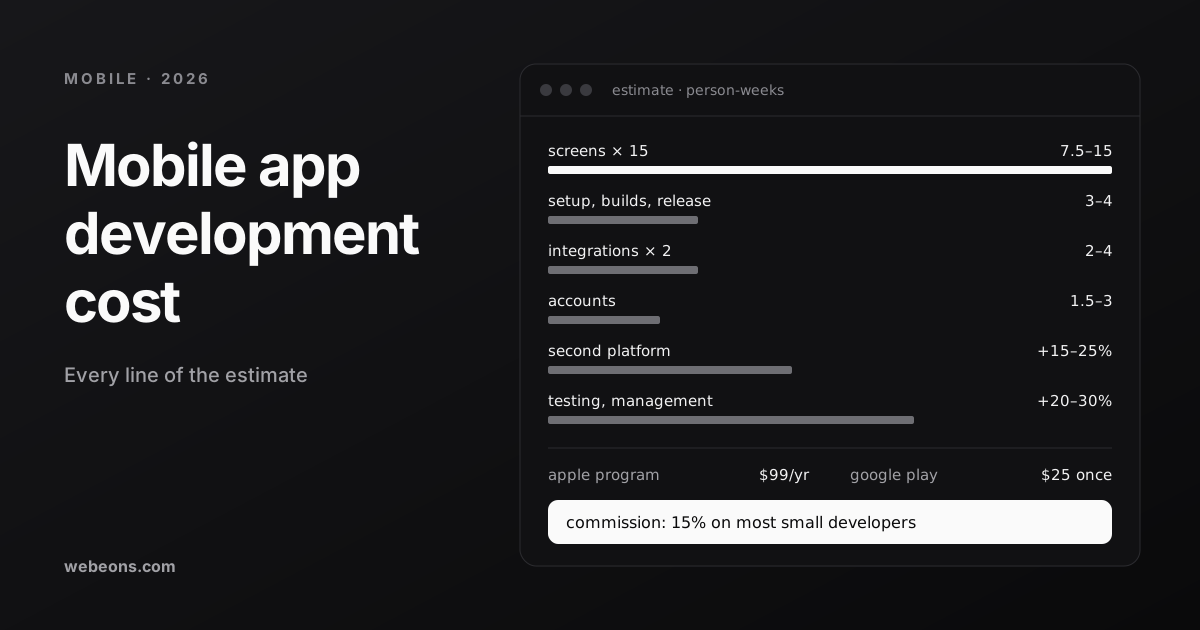
This estimator shows its working. Every line uses person-weeks that are our judgment, multiplied by a rate you control. The default rate of $65 an hour is the US median software developer wage, $135,980 in May 2025 according to the Bureau of Labor Statistics, divided by 2,080 hours. It is a wage with no overhead, so replace it with the rate on your quote.
What Actually Drives the Budget
Move the controls and three patterns show up.
Screens are not equal, but they are the best rough unit. A settings screen takes hours. A feed with filters, empty states and loading states takes much longer. We use half a week to a week as an average, and the top of that range is the safer one for a first version. The most effective cost cut is still removing screens.
Two native apps roughly double the work. Droids On Roids' own table prices native at about 1.7 times Flutter at every size. Unless you need deep platform access, one codebase is the cheapest large decision you can make. Which codebase is a question for the framework comparison.
Offline sync is the line that surprises people. Reading cached data is simple. Letting two devices edit the same record without a connection means deciding who wins, and that decision reaches into your data model. If you can launch with read-only offline, do.
Payments deserve the same caution. Subscriptions look like one feature and turn out to be restores, upgrades, refunds, failed renewals and store notifications. Apple's guideline 5.1.1(v) also requires in-app account deletion if you support account creation, which is a small feature that many first scopes forget.
What Shelf Inn Cost Us in Engineering Terms
Shelf Inn is our own home library app for the web, iOS and Android, with a real-time 3D room. The web app is live, and the iOS and Android apps are built with public release still ahead. We are not publishing a dollar figure for it. We can tell you where the engineering went, and few of these items would appear on a first estimate.
| Unplanned line | What happened | What it cost |
|---|---|---|
| Package size | The first Android bundle was 126 MB, because 3D models were copied in | A loader rule to stream them, 4.2 MB after, and a connection needed for first use |
| Performance pass | One tap froze the page for 2,729 ms | Moving the hot path out of React, then batching updates |
| Phone limits | iOS killed the web view on a 1,027-book library, with no error event | A phone tier with its own render budget, a crash sentinel, and a limit of 800 books on phones |
| Release pipelines | Signed builds for each platform | Xcode Cloud and GitHub Actions to set up and keep working |
| A server for a phone app | Vision provider keys have to stay off the device | A proxy we run and maintain |
One decision saved real money: one codebase across all three platforms, so every fix reaches all of them and the web build doubles as a test bed. It has a price too, because device problems such as iOS killing a heavy page have to be solved in web code. This class of work is why we would plan toward the top of your range for a first app, and keep the difference out of the feature list.
What an App Costs After Launch
Netguru and Droids On Roids both publish 15% to 20% of the original build as yearly maintenance, with both also printing 25% as an upper figure elsewhere. These are agency numbers, but the reason behind them is verifiable. The stores set deadlines, and missing one blocks your updates.
- Apple: since April 28, 2026, uploads must be built with Xcode 26 or later using an iOS 26 SDK. Since September 9, 2026, iOS apps must target iOS 13 or later.
- Google: since August 31, 2026, new apps and updates must target Android 16 (API level 36), with extensions available to November 1. Older apps lose reach to new users on newer devices.
Add hosting, error monitoring, support and whatever third-party tools you adopted. Ask any vendor what is included after launch, and for how long.
Where This Is Heading
Three dated changes could alter your numbers.
- Google's fees are still rolling out. Its March 2026 post sets the rest of the world for September 30, 2027. If most of your users sit outside the US, UK, EEA and Australia, check which rates apply before you model revenue.
- Apple's link-out terms are unsettled. Apple's July 2026 filing says the Ninth Circuit held in December 2025 that it can charge some commission on link-out purchases, and that the Supreme Court agreed on June 30, 2026 to review the contempt standard. Do not build a pricing plan that depends on today's zero-commission position.
- Android distribution is getting identity checks. Google's developer verification began protecting installs in Brazil, Indonesia, Singapore and Thailand on September 30, 2026, and expands globally in 2027 and beyond. If you plan to distribute outside Google Play, budget for it.
What We Would Do First
- Write down every screen, then delete a third of them.
- Decide whether you sell digital goods, because that sets your commission for years.
- Run the estimator twice: once for the app you want, once for the smallest app worth shipping.
- Get two quotes and make each one state what it excludes.
- Hold 15% to 20% of the build for the first year after launch.
If an AI tool built your first version, read our production checklist before you budget for a rebuild. If your product is a subscription web app first, our SaaS cost guide fits better. When you are ready, our mobile app service covers design through store submission, and you can send us your screen list for a straight answer on where it sits in these ranges.
Sources (20)
Common questions
How much does a mobile app cost in 2026?
Netguru publishes $15,000 to $50,000 for a simple app, $50,000 to $150,000 for a moderate cross-platform app and $150,000 to $300,000 or more for a complex one. Droids On Roids publishes higher figures. These are agency asking prices, so check what each one excludes.
How much do the App Store and Google Play charge to publish an app?
The Apple Developer Program costs $99 per membership year, and Google Play registration is a one-time $25. Those fees are small next to commission on digital sales.
What commission do Apple and Google take in 2026?
Apple charges 15% under its Small Business Program. Google's service fee starts at 10% on your first $1 million of annual earnings, plus a 5% billing fee if you use Google Play billing in the US, UK or EEA. Larger developers and other markets pay different rates.
How much does it cost to maintain a mobile app?
Netguru and Droids On Roids both publish 15% to 20% of the original build per year, and each also prints 25% as a higher figure. Store deadlines make some of this work unavoidable.
Find out which line is driving your budget
Send us your screen list and how you plan to charge. We'll tell you where it sits in these ranges, what to cut first, and what we'd leave for version two.