WordPress Alternatives in 2026: Where to Go, and When to Stay
A fair comparison of Webflow, Framer, Astro, Next.js, Ghost and Shopify, with prices read this month and a picker that can tell you to stay put.
The best alternative to WordPress depends on why you want to leave, and for many sites the right result is to stay. If your site works, your team can edit it, and someone owns its updates, a migration buys you risk and a bill. If it has become slow, fragile or wrong for what your business now does, there are good options, and they differ more than most comparison lists admit.
Declare our interest first. We sell WordPress migrations to Next.js, so we gain when you move and we gain most from one of the options below. We also think several of the others are the better choice for many sites. Two questions are covered elsewhere: our WordPress vs Next.js comparison goes deep on that one pairing, and our redesign guide covers how to move without losing search traffic. This article is about where to go.
Is WordPress Losing Market Share?
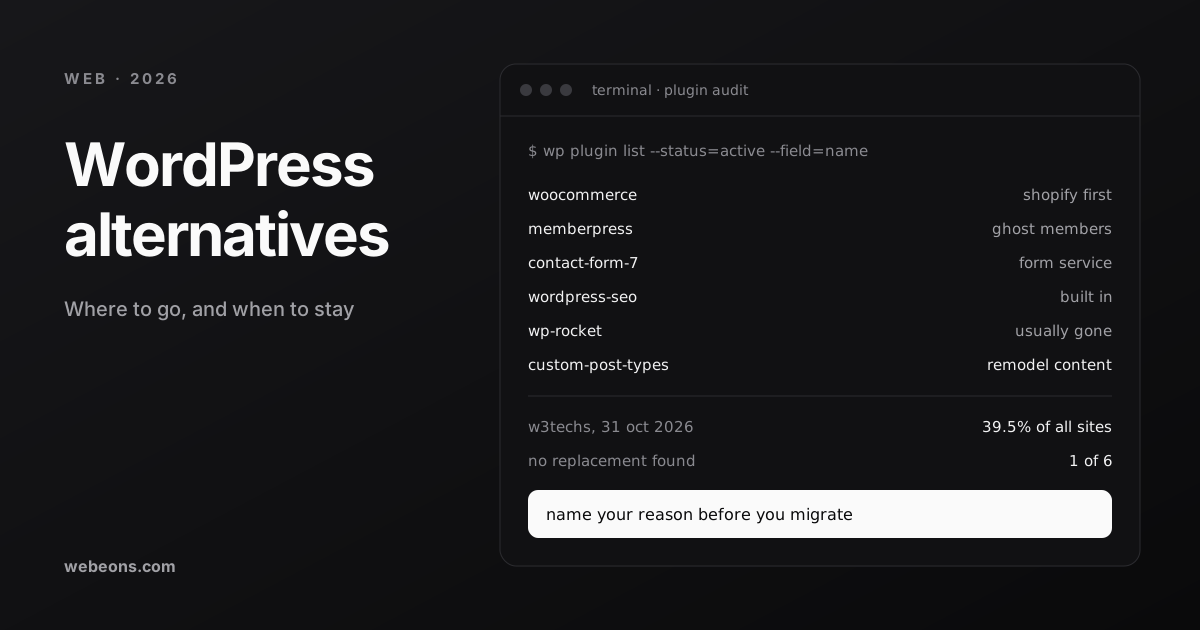
Yes. We read W3Techs directly on October 31, 2026: WordPress runs 39.5% of all websites and 58.2% of sites with a CMS W3Techs can identify. Search Engine Journal, using the same source, reported 43.2% in December 2025 and 41.9% on May 27, 2026, after six straight monthly drops.
Keep this in proportion. WordPress is still more than seven times the size of Shopify on this measure. Search Engine Journal did not establish a cause, and noted only that the slide lines up in time with the WP Engine dispute. WordPress is also actively shipping: version 7.0 arrived on May 20, 2026, 7.1 on August 19, and 7.2 was in beta in late October. Market share is a reason to look around. It is not a reason to migrate.
When Staying on WordPress Is the Right Call
Stay if any of these describe you, and spend the migration money on fixing what you have.
- You have a large archive with working search traffic. Every move puts that at some risk, and Google warns of ranking fluctuations while it reprocesses a site.
- Your editors are happy. A team that publishes daily without a developer has something valuable.
- You depend on plugins with no real replacement. Astro's own docs warn that you may need to build many features yourself.
- Your actual problem is hosting or too many plugins. That is a cleanup, not a platform change.
If you stay, take the upkeep seriously. Patchstack, a security vendor with a product to sell, counted 11,334 new vulnerabilities in the WordPress ecosystem in 2025. It attributes 91% to plugins and 9% to themes, with only six in core, and says 46% had no developer fix when they were disclosed. So the risk sits in what you install. WordPress also shipped a critical security fix, 7.1.2, on September 22, 2026, which is the kind of update someone must apply promptly. If nobody owns that job, managed hosting is a cheaper fix than a migration. WordPress.com's Business plan, with plugins and real-time backups, is $25 a month billed yearly.
The real reasons to leave are specific: the site has become a product, a store has outgrown its setup, plugin upkeep keeps breaking things, or your business needs a design your theme cannot give you. Name yours before you read on.
WordPress Alternatives Compared
These are not six versions of the same thing. Three are hosted platforms, one is a publishing system, and two are developer frameworks where you own the code.
| Platform | Best for | Who edits | Moving from WordPress | Main risk |
|---|---|---|---|---|
| Webflow | Marketing sites | Marketers, visually | Rebuild design, import content | Vendor lock-in |
| Framer | Small designed sites | Designers | Rebuild | Plan limits |
| Astro | Fast content sites | Developers, or a CMS | Export to Markdown, or keep WordPress as the CMS | You build the missing features |
| Next.js + headless CMS | Products and complex sites | Editors in the CMS | Full rebuild | Highest cost, needs developers |
| Ghost | Publishers and memberships | Writers | Built-in migrator, with limits | Narrow by design |
| Shopify | Stores | Store staff | Move products, customers and orders | App costs and fees |
What Each Alternative Costs
These are the published entry prices, read on October 31, 2026. Check them on the day you decide, because they move: Webflow rebuilt its plans in May 2026, folding CMS and Business into one Premium plan.
| Platform | Published price per month | Limit to check |
|---|---|---|
| WordPress.com | Personal $4, Premium $8, Business $25, Commerce $45, billed yearly | Monthly billing costs more: Business is $40 |
| Webflow | Basic $15, Premium $25 billed yearly. $25 and $39 billed monthly | Bandwidth on Premium is 50 GB, with paid add-ons |
| Framer | Free, Basic $10, Pro $30 | Basic allows 30 pages and 1,000 CMS items, Pro 150 pages and 2,500 items, with paid add-ons |
| Ghost(Pro) | Starter $18, Publisher $29, Business $199, billed yearly | Starter has no paid subscriptions. Members are capped by plan |
| Shopify | Basic $29, Grow $79, Advanced $299, billed yearly | Card fees and apps come on top |
| Astro | The framework is free and MIT licensed | You pay for hosting and any CMS you add |
| Next.js with Sanity on Vercel | Sanity free tier or $15 per seat. Vercel Pro $20 | Vercel's Hobby plan is for non-commercial use only |
None of these prices will decide the question for a business site. A difference of $20 a month is small next to a single rebuild. What does matter is what breaks a plan: Framer's page count, Ghost's member tiers, or a per-seat CMS bill once your team grows.
Find Your Best Alternative
Six questions give a recommendation and its main downside, and "stay" is a real answer. Each choice adds points, shown in the bars so you can see what moved them. The points are our opinion, and we sell one of these options, so argue with them.
What Your Plugins Become
This is the exercise that settles most decisions. List every active plugin, then write down what would replace it on your target platform. If you run WordPress with WP-CLI, one command gives you the list. If several lines have no replacement, you have your answer, or a real build cost.
Migrate From WordPress to Webflow
Webflow fits a marketing team that wants to publish and redesign without a developer. Plan on a rebuild. Webflow's help center says there is no automated way to convert a site from another platform, and its documented route is to export WordPress data as XML, convert it to CSV and upload it to CMS collections. Third-party apps exist in its marketplace. Your theme, plugins and custom fields do not come across on their own, so count them first.
Migrate From WordPress to Astro
Astro's docs describe two routes. You can switch fully, converting posts to Markdown and working from a starter template. Or you can keep WordPress as your CMS, so writers stay in the dashboard while Astro builds the public site. The second route is underrated, because it keeps your editors happy and removes WordPress from the front of your site, although you still run and update it.
The trade-off is plain in the docs: a WordPress site is edited in a dashboard, while Astro uses a code editor and files in a project, and you may need to build features yourself. If non-developers edit daily, plan for a headless CMS or stay on the dashboard route. Its migration page gives no redirect steps, so plan that work yourself.
Next.js, Ghost and Shopify
Next.js with a headless CMS is the heaviest option here and the one we sell. It earns its cost when the site is really a product, with logins, dashboards or custom logic. For a brochure site, it is usually too much. The detail is in our dedicated comparison.
Ghost is the simplest move for a publisher. Its built-in migrator takes XML exports up to 100 MB and up to 2,500 posts, turns categories into tags, and supports common shortcodes. Custom post types are not supported, and most uncommon shortcodes will not convert. Larger sites need Ghost's migration team or its open-source tools, and you may need to add redirects so backlinks still land correctly.
Shopify is the default for a store that has outgrown WooCommerce. Do not move a content-led site to it because of one small shop. W3Techs has it as the second-largest CMS, at 5.3%.
Whichever you pick, the search work is the same. Google's guidance is to keep redirects for at least a year, and larger sites take longer to settle. Our redesign guide has the checklist.
Where This Is Heading
Three dated shifts are worth watching.
- WordPress's share kept falling after May. It went from 41.9% on May 27, 2026 to 39.5% on October 31 on W3Techs. Treat that as a trend to watch, with no agreed cause yet.
- Astro has a large backer. Astro's company joined Cloudflare, announced January 16, 2026, and it says Astro stays open source under the MIT license. Search Engine Journal reported about 2.5 million weekly downloads in May 2026, up from about 1.4 million in 2025. Downloads measure developer activity, not live sites.
- Hosted platforms can reprice you. Webflow's plan changes began on May 13, 2026, and some existing sites move as late as November 16. That is the trade you accept on any hosted platform, so count it as a risk.
What We Would Do First
- Write down the one reason you want to leave. If you cannot, stay.
- Run the plugin audit and mark anything with no replacement.
- Export your top pages by search traffic, so you know what must survive.
- Rebuild one real page on your top choice before you commit.
- Price the migration, not the subscription.
Our WordPress migration service is listed at $10,000 to $35,000, and it is built around moving to Next.js. If the picker says Ghost, Shopify or staying put, follow that. If you want a second opinion, send us your plugin list and your reason for leaving, and we will tell you where we would go, including nowhere. If you are planning a new site from zero, our website cost guide is the better starting point.
Sources (19)
Common questions
What is the best alternative to WordPress in 2026?
It depends on the site. Shopify suits stores, Ghost suits publishers, Webflow or Framer suit marketer-run sites, Astro suits developer-run content sites, and Next.js with a headless CMS suits products. Many working sites should stay on WordPress.
Is WordPress losing market share?
Yes. W3Techs showed 39.5% of all websites on October 31, 2026, and Search Engine Journal reported 43.2% in December 2025 from the same source. The cause is not established, and WordPress is still far larger than any rival.
Can I migrate from WordPress to Webflow automatically?
Not fully. Webflow's help center says there is no automated way to convert a site. The documented route exports WordPress data, converts it to CSV and imports it to the CMS, and the design is rebuilt.
How do I migrate from WordPress to Astro?
Astro's docs give two routes: move fully and convert posts to Markdown, or keep WordPress as your CMS and build the public site in Astro. You handle redirects and any plugin features yourself.
Find out whether you should move at all
Send us your plugin list and your reason for leaving. We'll tell you where we would go, what it would cost in our listed range, and when staying is the better call.