How to Choose a Software Development Company (2026 Guide)
What to check, which red flags stop a deal, who owns the code in the US and India, and how to run a small paid test. Written by a vendor, so test us too.
Most bad vendor choices come from comparing the wrong things: hourly rates, logo walls and how polished the proposal looks. Choosing a custom software development company should work more like hiring a senior engineer. You inspect real work, meet the actual people, test them on something small, and read the contract's ownership clause twice. This guide gives you the checks, the questions, and a scorecard to compare up to three vendors.
You should know where we stand. We are one of the companies you might be comparing, so we have an interest in this topic. Our working hours are GMT+5:30. We hold no security certifications. Apply every check below to us as hard as you would to anyone else.
First, Decide Whether You Need a Company at All
A development company is not always the right buy, and the alternatives are often better.
| In-house team | Freelancer | Development company | |
|---|---|---|---|
| Best when | Software is your core product for years | Scope is small and clear | You need several skills for a defined period |
| Strength | Deep context, long-term ownership | Direct contact, lower overhead | Range of skills, cover for absence |
| Main risk | Slow to hire, hard to reverse | One person is a single point of failure | Your account gets junior staff |
| Ownership by default | Employer, generally | Needs a written assignment | Needs a written assignment |
If software is the heart of your company and you can afford to wait for the right hire, hire. A good senior engineer who stays for five years is worth more than any vendor. If your project is one integration with a clear brief, a strong freelancer will likely be faster and cheaper than we would be. A company makes sense when you need a designer, frontend, backend and someone accountable for all of them, for a defined stretch. A middle route is one dedicated engineer working inside your team.
What to Check, in Order of Importance
The order matters. The first items are hard to fix later, and the last ones you can improve along the way.
- Ownership and access. Who owns the code, and whose accounts hold it? This outranks everything, because it decides whether you can ever leave.
- Evidence of comparable work. Ask for a live product you can use, and then ask what went wrong on it. A team that can name a failure and its fix has really shipped. Be wary of anyone who has only success stories.
- The real team. Meet the people who will write your code. Ask who leads technically, and how much of their time you get. Ask directly whether subcontractors are involved.
- Engineering habits. Ask to see one real pull request, with its review comments and tests. You do not need to read the code. You are looking for whether someone else checked it, and whether anything was pushed back.
- Communication. Judge this from the sales process, because it rarely improves after signing. Note whether they answer the question you asked, and whether they say "I don't know".
- How they scope. A vendor who quotes a fixed price within a day has either padded it heavily or not understood the job. Good ones ask awkward questions first. See our note on fixed-price and hourly billing.
Questions to Ask a Software Development Company, and a Scorecard
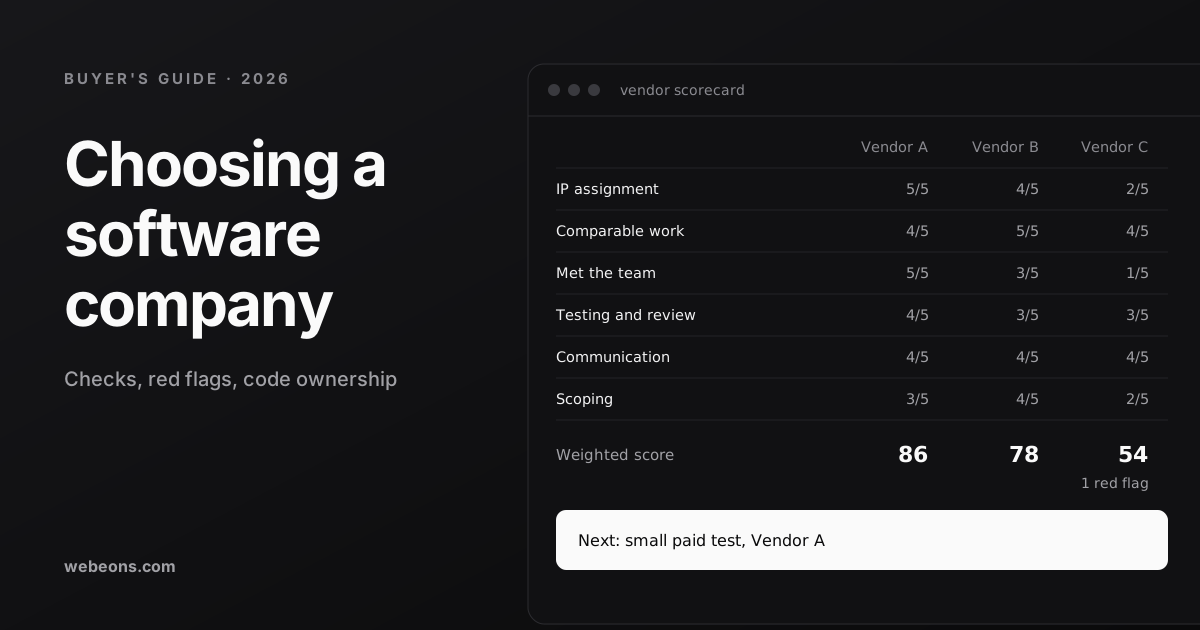
Use the same questions with every vendor and score the answers the same day. The weights below are ours, and they lean heavily toward ownership and evidence. A red flag overrides the score, because a vendor who will not assign your IP is not rescued by a nice portfolio. The copyable question list is in the panel, ready for an email.
Red Flags That Should Stop the Deal
- The repository lives in their account. Your company should own the code host, cloud account, domain and app store accounts from the first day, and grant the vendor access. Reversing this later depends on their goodwill.
- Bait and switch. Senior people sell, and juniors arrive. Name the team in the contract, with a right to approve changes.
- No questions about your business. A team that agrees with everything has not yet found the hard parts.
- Certification claims with no report. A security claim is only as good as the document behind it. If a vendor says SOC 2, ask for the report and check whether it is Type 1, which looks at design at one point in time, or Type 2, which tests how controls operated over a period, per audit firm Schellman. A vendor with no certification, as we are, should say so and describe its actual practices.
- No written handover terms. If leaving is undefined, it will be expensive.
Who Owns the Code
This is the section most buyers skip, and the one that can cost the most. We are engineers, so treat this as a list of things to raise with your lawyer.
In the United States, paying for software does not by itself make you the owner. The Copyright Office's Circular 30 says a work is made for hire when an employee creates it within regular duties, or when a commissioned work falls into one of nine statutory categories, with a signed agreement. Those categories include items such as a translation, a test and an atlas, and software does not appear by name. A signed work-for-hire label alone may therefore not be enough for a contractor's code, which is why contracts add a present assignment. Under 17 U.S.C. § 204, a transfer of copyright ownership must be in writing and signed by the owner of the rights.
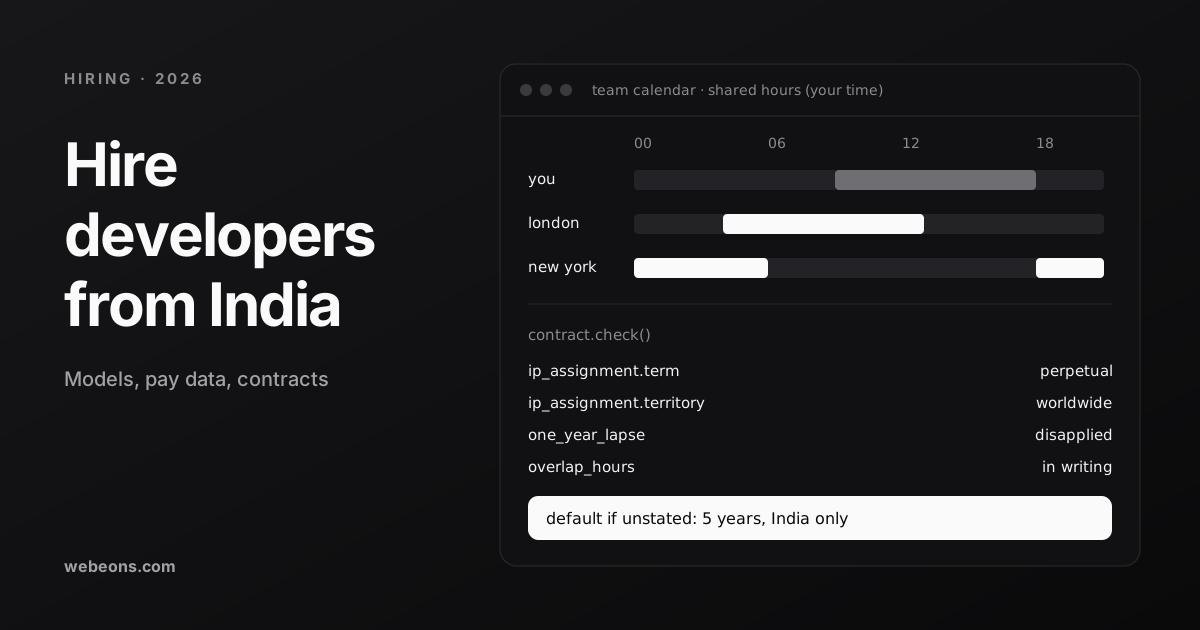
In India, the defaults are sharper. Section 17 of the Copyright Act, 1957 makes an employer first owner under a contract of service, absent contrary agreement. A contractor's position differs. Section 19 then sets the trap: if an assignment does not state its period, it is deemed to be five years, and if it does not state the territory, it is presumed to extend within India. In Pine Labs v. Gemalto, a 2011 Delhi High Court decision on commissioned software, those defaults applied to an agreement that was silent on both. Section 19(4) also says an assignment can lapse if the rights go unexercised within a period.
| Clause | What to look for |
|---|---|
| Assignment | "Hereby assigns" all rights, effective on creation or on payment, with moral rights waived where the law permits |
| Term and territory | Stated in words: full term of copyright, worldwide |
| Subcontractors | Every person who touches the code has assigned rights up the chain |
| Pre-existing code | Vendor's own libraries are listed, with a perpetual license to you |
| Open source | Licenses listed, with approval needed for anything that imposes obligations on your code |
| Personal data | If GDPR applies, a processor contract under Article 28, including return or deletion at the end |
| Exit | Handover period, documentation, access removal, and data return |
| Governing law | A court or arbitration venue you could really use |
Run a Small Paid Test First
The strongest filter we know is two weeks of paid work on something real. It costs little compared with a bad six-month contract, and it replaces opinions with evidence. Fair vendors welcome it. Here is how we would set one up as a buyer:
- Pick a small, real slice, such as one feature or one integration, and write the brief in a page.
- Pay for it at normal rates. Unpaid tests attract the wrong vendors and get your work half-done.
- Require the work in your repository, with commits from named people.
- Ask a neutral engineer to review the result for an hour. If you have none, pay one.
- Compare what you got against four things: did it run, could someone else change it, how were surprises reported, and were the estimates honest?
Pay attention to how bad news arrives. Every project hits a surprise. In a two-week test you will see whether they tell you on the day it happens or at the end.
Choosing a Software Development Company in India and Offshore Time Zones
India has strong engineers, and a wide range of quality, like any large market. Rate differences can be real, but a low rate buys nothing if a task takes three attempts. Judge an Indian vendor by the same list you would use anywhere else. Then deal with the two things that are different: the law above, and the clock.
India runs on UTC+5:30 with no daylight saving, while US clocks change on November 1, 2026 and UK clocks on October 25, so the gap moves through the year. A standard 9:30 to 18:30 day in India covers 4:00 to 13:00 in London in winter, which is workable. In New York it covers 23:00 to 08:00, so a 9-to-6 office shares no hours at all. Move the slider to see what it takes.
Full overlap is rarely needed. We would ask for a short daily window of two to three hours, a written update at the end of each day, and a named person for outages. Some work suits the gap, since a reviewer can pick up finished code by morning. Live debugging with your team does not. Put the agreed hours in the contract, including what happens around holidays, and whether the people keeping those hours are the same people doing the work.
Where This Is Heading
Two shifts already change what you should ask.
- AI output complicates ownership. The US Copyright Office concluded in January 2025 that AI outputs can be protected only where a human author determined sufficient expressive elements, and that prompts alone do not qualify, while using AI to assist does not bar protection. If your vendor generates much of the code, ask how it is reviewed and changed by people, and take legal advice on what that means for your assignment.
- Speed proves less than it did. Google's DORA team reported in 2025 that AI acts as an amplifier, magnifying the strengths of high-performing organizations and the dysfunctions of struggling ones. So a fast demo tells you little, and the engineering habits in your checks matter more. Our production checklist for vibe-coded apps shows what fast output tends to skip.
Make the Decision on Evidence
Shortlist three, send the same questions, score the answers, and run a paid test with your favorite. If you are comparing other routes too, read agency vs in-house. If we are on your list, send us the question list and hold us to it. We would also happily start with a small test, or with a single dedicated engineer.
Sources (12)
Common questions
How do I choose a custom software development company?
Check ownership terms first, then inspect comparable work, meet the actual engineers, review a real pull request, and run a small paid test before signing a larger contract.
What questions should I ask a software development company?
Ask who will do the work, whether IP is assigned in writing, whose accounts hold the code, whether subcontractors are used, how code is reviewed, what happens when scope changes, and what you receive if you part ways.
Who owns the code when you hire a development company?
It depends on the contract and the law that applies. Do not assume payment transfers ownership. In the US a transfer must be in writing and signed. In India, an assignment that omits its term and territory defaults to five years and India. Take legal advice.
How do time zones work with a team in India?
India is UTC+5:30 with no daylight saving. In winter a standard India day shares no hours with a standard New York day, so agree a daily overlap window, a written update routine and an outage contact in the contract.
Put your vendor questions to us
Send us the question list and a short brief. We'll answer in writing, tell you if a freelancer or an in-house hire would serve you better, and suggest a small paid test.