How Much Does It Cost to Build an App With AI in 2026?
The subscription is the small part. Here is what Lovable, Replit, Bolt, Base44, Cursor and Claude Code charge today, what the bill looks like after credits, backend, review and upkeep, and a calculator for your own app.
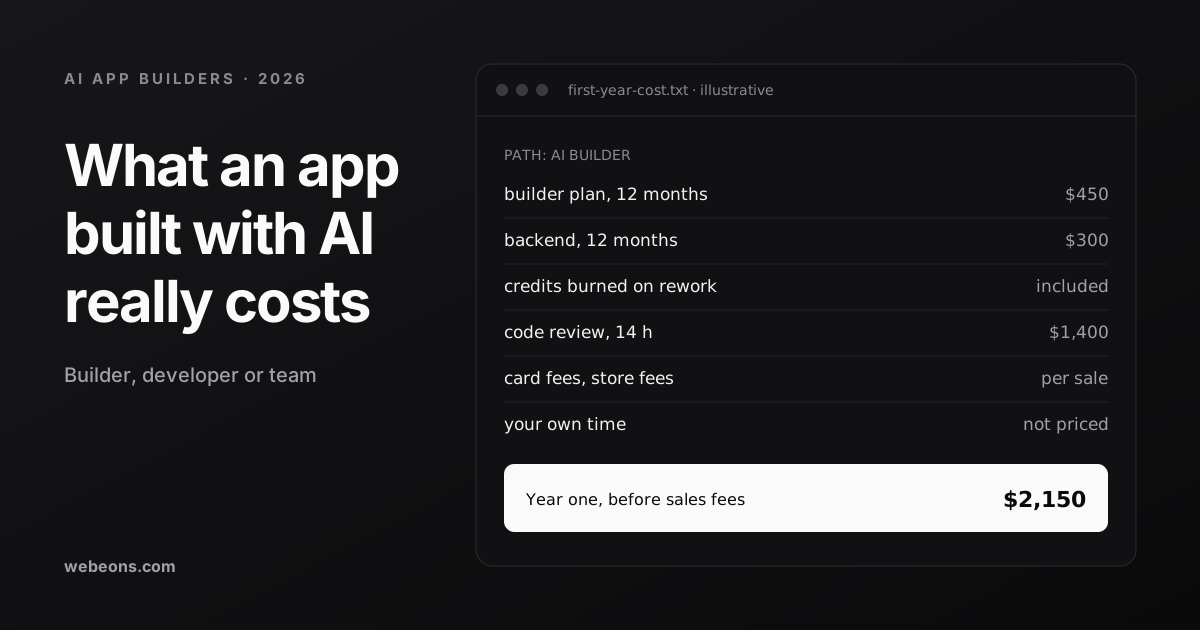
Building an app with AI can cost $25 a month, and that figure answers the wrong question. The subscription buys you a first version. The bill you should plan for covers credits you burn fixing things, a backend that stays online, a person who checks the security, store fees and a year of upkeep. Here is what each tool charges today, what sits around that price, and how to pick between an AI builder, AI plus a developer, and a team.
What AI App Builders Cost Right Now
We read each vendor's own pricing page on October 31, 2026. These change often, so check again before you budget. Annual billing is cheaper on most of them.
| Tool | Free tier | Paid plans | What the meter counts |
|---|---|---|---|
| Lovable | 5 credits a day, up to 30 a month | Pro $25 for 100 credits, rising to $2,250 for 10,000 | Credits. Top-ups $0.30 each on Pro |
| Replit | Not shown on the pricing page | Core $20, Pro from $100 | Effort-based credits, which also cover published apps, storage and databases |
| Bolt | 1M tokens a month, 300K a day | Pro $25, Teams $30 a member | Tokens. 10M a month on Pro |
| Base44 | 25 message credits a month | $16, $40, $80, $160 | Message credits, 100 to 1,200, plus integration credits |
| Cursor | Limited requests | Plus $8, Premium $30, Super $100, Ultra $200 | A weekly usage pool. Third-party models billed separately |
| Claude Code | Not on the free plan | Pro $20, Max $100, Ultra $200 | Plan limits, or tokens on the API |
Two tools get asked about by name, so here are direct answers. What does it cost to build an app on Base44? The published floor is $16 a month on annual billing, and the page says all plans include a backend, database and sign-in. The catch to check is ownership: GitHub integration begins at the $40 Builder plan.
What does it cost to build an app with Claude Code? The floor is the $20 Pro plan, and heavy users move up. Anthropic's documentation says that across enterprise deployments the average is around $13 per developer per active day and $150 to $250 per developer per month. That figure describes professional developers using it at work, so treat it as a guide to full-time use and remember what it leaves out. Claude Code and Cursor write code. Hosting it, deploying it and fixing it at midnight stay with you. They suit someone who can read what comes back.
Why So Many New Apps Exist, and What That Tells You
The surge showed up early in the year. TechCrunch reported on April 18, 2026, that Appfigures counted worldwide app releases up 60% year over year in the first quarter, and iOS up 80%. TechCrunch called the link to AI coding tools a working hypothesis, which is the right level of caution. The Information, reported by 9to5Mac that month, said it was difficult to determine how many apps were built with AI.
Put the two numbers side by side. Supply doubled and demand barely moved. If building gets cheaper for everyone, a working app stops being the hard part. Spend what you save on finding out whether anyone wants the thing.
The Costs That Are Not on the Pricing Page
Five lines catch founders out. Each one is real money, and most arrive after the excitement of the first demo.
- Credits spent on rework. A plan's credits go on fixes as well as features. Replit bills by the effort a request takes, so its docs warn that complex work costs more, and plan mode can be charged even when no code changes. Lovable's monthly credits expire two months after issue on monthly plans. Set a spend limit before you start.
- The backend. Lovable says hosting is covered by its included grant for most small apps, and that apps reaching significant traffic or size may start incurring cost. If you run your own, Supabase's free tier pauses projects after a week of inactivity, and its Pro plan starts at $25 a month.
- A security review. Generated code can pass every demo and still expose data. Our vibe-coded app checklist covers what to look for and has a five-minute audit. Budget for a person to do this once before launch, and again after any big change.
- Payment and store fees. Stripe's standard US rate is 2.9% plus $0.30 per transaction. Apple charges $99 a year and takes 15% on paid apps and in-app purchases under its Small Business Program, for developers earning up to $1 million. Google Play has a $25 one-time registration fee.
- Maintenance. Software left alone decays. Dependencies age and models retire. OpenAI told developers on October 14, 2026, that gpt-4o leaves its API on January 14, 2027, which is three months' notice. If your app calls a model, someone has to handle that. Our migration guide shows what that work looks like.
Calculate Your Own Three Paths
The calculator compares the three paths on your answers. Plan prices come from the pages above, and the team figure comes from our listed MVP range. The hours are our judgment, shown beneath the result so you can disagree with them. The rate is yours to set. For scale, the US Bureau of Labor Statistics put the median software developer wage at $135,980 in May 2025, which works out to about $65 an hour over a 2,080-hour year before any employer costs, so $100 is a planning figure, not a market rate.
How to Choose Between the Paths
The default case above comes to about $2,150, $12,800 and $69,300. The gap is large, and the cheapest row can still be the expensive choice. Look at what each path leaves in your hands.
| AI builder | AI plus a developer | A team | |
|---|---|---|---|
| Best for | Testing demand | A focused product with real users | Several roles, regulated data, deadlines |
| Who reads the code | Nobody, unless you pay for it | Your developer | The team |
| When it breaks | You prompt and hope | Your developer, if available | Whoever your contract names |
| Biggest risk | Unseen security holes | Reliance on one person | Paying before you have proof |
| Exit | Check export terms first | You own a normal codebase | You own it, if the contract says so |
We sell the third path, so weigh our view accordingly. Even so, most founders with an unproven idea should not start there. Our listed $40,000 to $80,000 is a poor price for a question that a $25 plan and a landing page can answer. If you are choosing what goes into a first paid build, our guide on what an MVP should cost works through that decision.
What we would do first: build the rough version yourself on a builder, put it in front of ten real people, and take no payments. If they come back, bring in a developer before you add money or personal data. That order keeps your early spending small and puts the review at the moment it starts to matter.
Where Cheap First Versions Turn Into Engineering
Two details from our own products show where cheap first versions turn into paid engineering. Neither is exotic, and a builder can generate a working-looking version of both.
Charging for long AI jobs is one. In BlurbBio, our AI writing platform, a request can time out while the job behind it keeps running, which would leave credits held for work the author never saw. So each job reserves credits against its own ledger key, commits only when the result is delivered and releases otherwise, and sweeps reconcile anything left open. A retry can't charge twice. The happy path takes minutes to generate. The failure paths are the job.
Provider keys are the other. Shelf Inn, our home library app for iOS and Android, reads book spines with vision AI through a server proxy that keeps provider keys off the device. A shipped app with a key inside it hands that key to anyone who looks, and your model bill goes with it.
If Your App Is Going in the App Stores
Budget time for review, and design for it. Apple's guideline 4.2 says an app should include features, content and UI that elevate it beyond a repackaged website, so wrapping a builder's web app may not be enough. If your app lets people create an account, guideline 5.1.1(v) requires you to offer account deletion inside the app. For the wider budget and framework choice, read our framework guide and see our mobile app service.
Where This Is Heading
Three dated shifts should shape how you budget.
- Stores are raising the bar. In June 2026, 9to5Mac reported that Apple tightened guideline 4.3(b) with the line "Don't submit apps that are indistinguishable from what's already widely available." An AI-built clone of a common app type now carries real rejection risk.
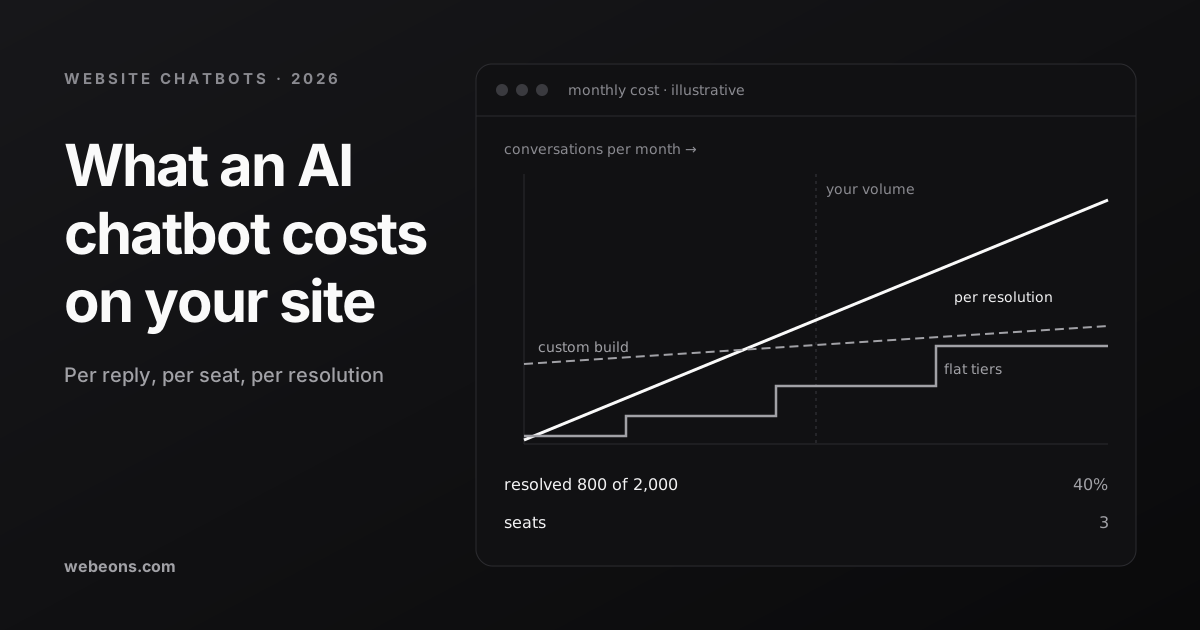
- Plans are becoming meters. As of October 2026, Lovable sells credits, Replit bills by effort, and Cursor's allowance refreshes weekly with top-offs on sale. A fixed monthly budget needs a spending cap to stay fixed.
- Model upkeep is now routine. The gpt-4o notice gave developers three months. Any app with AI inside should assume a model swap every so often and keep a test set ready to catch what changes.
Start Small, Then Pay for the Risky Parts
Use the cheapest path that matches what can go wrong. If you have built something and want to know what it needs before real users arrive, send it to us and we will tell you what to fix, what to keep and whether you need us at all. When it is time for a proper first release, our MVP development page sets out what is included.
Sources (23)
Common questions
How much does it cost to build an app with AI?
Entry plans on the main tools ran $16 to $25 a month on pricing pages read October 31, 2026. In our illustrative case of a web app with accounts and payments, year one comes to about $2,150 on a builder with a paid code review, $12,800 with a developer, and $69,300 with a team.
How much does it cost to build an app with Claude Code?
Claude Code is included on the $20 Pro plan, with Max at $100 and Ultra at $200 a month. Anthropic's docs put the enterprise average at around $13 per developer per active day and $150 to $250 per developer per month. Hosting and maintenance are separate.
How much does it cost to build an app on Base44?
Base44 has a free plan with 25 message credits a month, and paid plans of $16, $40, $80 and $160 a month on annual billing. Its page says all plans include a backend, database and sign-in. GitHub integration starts at the $40 Builder plan.
Can a non-technical founder launch an app built with AI?
Yes, for a test with no payments and no personal data. Once an app handles money or personal data, we recommend paying a developer to read the code before launch. Generated code can work in a demo and still expose data.
What are the hidden costs of building an app with AI?
Credits spent on rework, backend hosting as traffic grows, a security review, payment and app store fees, and ongoing maintenance such as moving to a new model when an old one retires.
Built something with AI and unsure what it needs next?
Send us the app or the idea. We'll tell you what is safe to launch, what to fix first, and whether a builder is still the right place for it.