Chatbot vs AI Agent: The Difference and Which You Need
One question separates them: who decides the next step, your code or the model? A plain guide to chatbots, workflows and agents, with a tool that recommends one.
Most people asking whether they need a chatbot or an AI agent are really asking how much control to hand over. The two words are used loosely enough that a vendor's label tells you almost nothing. A better test takes one question: when a customer asks for something, who decides the next step, your code or the model? Here is how to answer that for your own business, and why the middle option, a workflow, is the one most buyers never hear about.
The Difference Between a Chatbot and an AI Agent
Anthropic's engineering guide to agents draws the cleanest line we have found. Workflows are systems where models and tools are orchestrated through predefined code paths. In an agent, the model directs its own process and its own use of tools. That gives you three working categories:
- Chatbot. It reads and replies. A modern one uses retrieval, usually called RAG: it searches your documents and answers from what it finds. It changes nothing in any other system.
- Workflow. It finishes a task along a path you wrote. A model may classify a message or draft text, but your code decides the order.
- Agent. It has tools and a goal. It decides which tool to call, reads the result, and decides again until it finishes or hits a limit.
So "RAG chatbot vs agentic AI" is a question about who holds the steering wheel. An agent will usually use retrieval as one of its tools, which is why a retrieval bot is often the first stage of an agent rather than a rival to it.
| Chatbot | Workflow | Agent | |
|---|---|---|---|
| Who sets the path | Fixed: search, then reply | Your code | The model |
| Can change other systems | No | Yes, in the ways you wrote | Yes, within the tools you grant |
| Worst common failure | A wrong answer | An unplanned case | A wrong action, or a loop |
| What you must test | Answers | Each path and its errors | Decisions across many cases |
| Model calls per task | Usually one | One per AI step | Unknown until it runs |
| Good fit | Help content, product questions | Invoices, returns, routing | Varied cases across several systems |
One Question, Three Systems
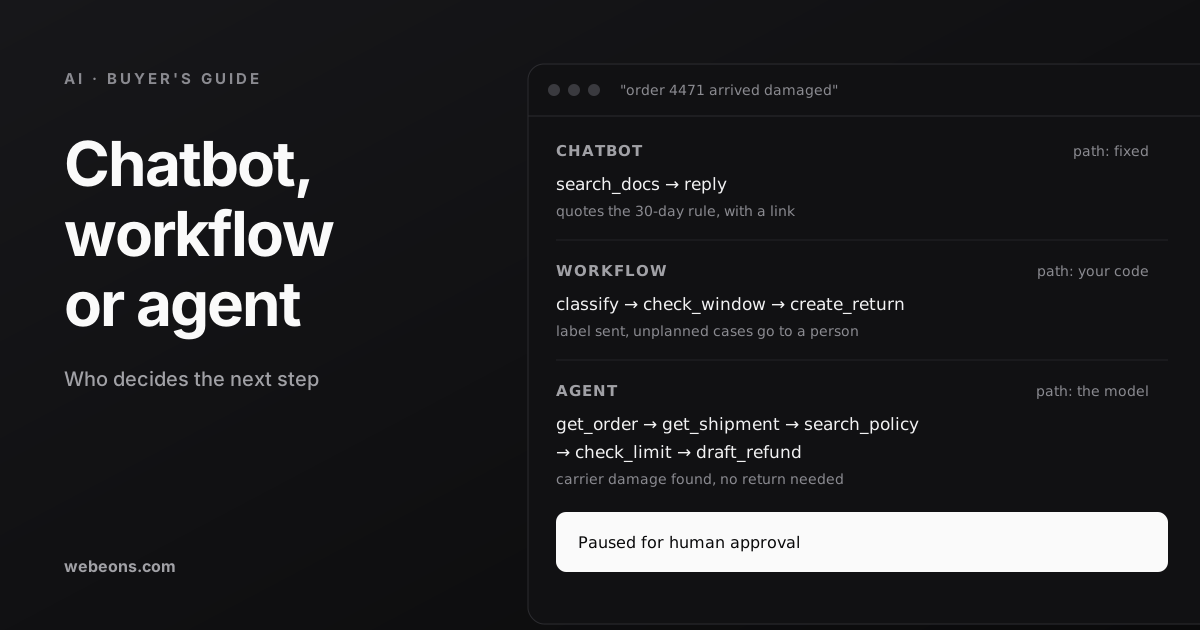
Definitions only go so far, so here is one damaged-order message handled by each. The chatbot gives a correct answer and leaves the customer to act on it. The workflow sends a return label, because someone wrote that path. The agent checks the shipment on its own initiative, finds a carrier note, and learns that no return is needed. Nobody scripted that step, and that is both the value and the risk.
Look at the last line of the agent's run. It stopped for a person, because the refund was above its limit. A well-built agent spends much of its life like that. The autonomy sits in gathering facts and proposing an action, and the permission to act gets widened slowly.
Which One Do You Need?
Six questions decide this for most businesses. The tool below uses plain rules, which we would rather show you than hide: the hardest of your first three answers sets the level. Agent-level work drops to a workflow if you hold fewer than 50 test cases, the low end of the 50 to 100 examples our AI agent cost guide recommends. That 50 and the volume bands are our judgment, not an industry standard.
Why We Would Start With the Chatbot
Anthropic's advice is to find the simplest solution possible and add complexity only when needed, and it notes that this might mean building no agentic system at all. It also says plainly that agentic systems often trade latency and cost for better task performance. That trade is worth it when simpler versions fall short. You only learn whether they fall short by shipping one.
A chatbot also gives you the two assets every later stage depends on: clean content and a log of what people really ask. Those logs become your test set. They show you which requests repeat, and repeated requests are workflow candidates. The rare, messy cases that remain are the honest case for an agent.
There is a fair argument against this. Anthropic names customer support as a strong fit for agents, since it pairs conversation with tool access and success can be measured in resolutions. If your support volume is mostly account-specific requests such as "where is my order" or "change my plan", an answer-only bot will disappoint. Skip ahead to a workflow for those paths.
A Bad Answer Is Already Your Liability
Being "only a chatbot" does not make the risk small. In Moffatt v. Air Canada, decided in February 2024, the airline's chatbot told a customer that a bereavement discount could be claimed after travel, which was wrong. British Columbia's Civil Resolution Tribunal rejected the airline's argument that the chatbot was responsible for its own actions, and ordered it to pay about C$812 in total. The sum is small. The principle, that the business owns what its bot says, is the part to remember.
This shaped how we built AskOrac, our own AI chatbot platform. With a loose threshold, a large document set returns dozens of weakly related chunks, and a model will blend them into a plausible answer that mixes fact with invention. So we made three decisions that any buyer can ask a vendor about:
- Prefer "I don't have that" to a guess. Strict mode raises the retrieval threshold and adds a confidence gate. Below it, the project's fallback message goes out in place of an improvised answer. Coverage drops, and for technical and product content we accept that.
- Score confidence from retrieval, not from the model. Asking a model how sure it is gives you a number nobody can explain. Our score combines similarity, chunk availability, keyword coverage and source diversity, which can be measured and explained. A strong score still does not prove an answer is right, so citations and review still matter.
- Make handoff a real path. Weak context now produces a fallback or a handoff in place of an invented answer. Outside office hours, the bot keeps answering and logs the questions it was unsure about for the team, so the follow-up queue fills instead of visitors going unanswered.
How to Read the Adoption Numbers
A jump like that invites panic buying, so read it next to two other figures. The same Salesforce release says 36% of organizations report that AI already handles case resolution autonomously, which is a much smaller group than the headline. And in June 2025 Gartner described "agent washing", the rebranding of assistants, automation and chatbots as agents without substantial agentic capability, estimating that only about 130 of the thousands of vendors deliver on the claim.
We could not find a neutral, cross-vendor resolution rate that we trust. Published figures come from people selling the tool, and they measure different things. When a vendor quotes one, ask for three details: how a resolution is defined, whether abandoned chats count as wins, and what share of your own tickets it would cover.
Questions to Ask Before You Sign
- Show me the steps of one real conversation. Which were chosen by the model, and which by code?
- What tools can it call, and which of them can change data?
- What stops a run: a step limit, a spend limit, or both? Anthropic's guide recommends stopping conditions such as a maximum number of iterations.
- What happens when it does not know? Show me the fallback.
- How does a person take over, and do they see the full conversation?
- How do I test a change before customers see it?
Buying can be the right answer. Fin charges $0.99 per outcome, with one outcome counted per conversation and a 50-outcome monthly minimum for its standalone option. For standard support on a standard help desk, that is a fair place to start, and worth pricing before you commission anything.
Where This Is Heading
Three shifts already visible will change this decision.
- Disclosure is becoming law. Goodwin's August 2026 alert confirms that EU AI Act transparency duties are in force: providers of AI systems that interact directly with people must ensure users are clearly informed, unless it is obvious from context. If you serve EU customers, label the bot now and take legal advice on your role.
- Connecting tools is getting easier. Anthropic donated the Model Context Protocol to a Linux Foundation fund in December 2025, reporting over 10,000 active public servers. Easier connections mean more agents with more reach, so the hard question shifts to permissions. Our guide on preventing prompt injection covers what happens when reach goes unchecked.
- Pricing is moving toward finished work. Fin already bills by outcome. Expect buyers to compare chatbots and agents on cost per resolved task, which rewards whichever system really finishes the job.
Choose the Lowest Level That Does the Job
You can always move up a level, and each move is easier with the logs and tests from the one before. If you want a second opinion, send us the task and we will say which level fits, including when the answer is an off-the-shelf tool. Our AI chatbot solution covers retrieval bots with handoff, and our AI integration service covers workflows and agents inside your own systems. For the money side, read what an AI agent really costs.
Sources (8)
Common questions
What is the difference between a chatbot and an AI agent?
A chatbot reads and replies. An AI agent has tools and a goal, and the model decides which steps to take. Between them sits a workflow, where a model helps inside steps that your code defines.
Is a RAG chatbot an AI agent?
No. A RAG chatbot searches your content and answers from it along a fixed path. An agent may use retrieval as one of its tools, but it also chooses its own next steps and can act in other systems.
Do I need an AI agent for customer support?
Often not at first. A retrieval chatbot with a human handoff covers informational questions, and workflows handle repeated tasks. An agent makes sense when steps vary by case, the systems are connected, and you have test cases to measure it. Anthropic does name support as a strong fit for agents.
Why do AI chatbots give wrong answers?
A common cause is weak retrieval: loosely related passages reach the model, and it blends them into something plausible. Stricter retrieval thresholds, a confidence gate and a fallback message reduce this at the cost of answering fewer questions.
Not sure which level your task needs?
Send us the task, how often it happens and the systems it touches. We'll tell you whether a chatbot, a workflow or an agent fits, and whether you should just buy a tool.