How Much Does It Cost to Build an AI Agent in 2026?
Published build prices run from $20K to over $200K. Here's what drives the number, a worked monthly running cost, and how to avoid paying for an agent you don't need.
When a client asks what an AI agent costs, the useful first question is what the agent is allowed to do on its own. A bot that reads your help center and a system that issues refunds across three platforms both get called agents, and one can cost ten times the other. Here is how we would price the work, what it costs to run, and where the budget usually goes wrong.
First, Work Out What You Are Buying
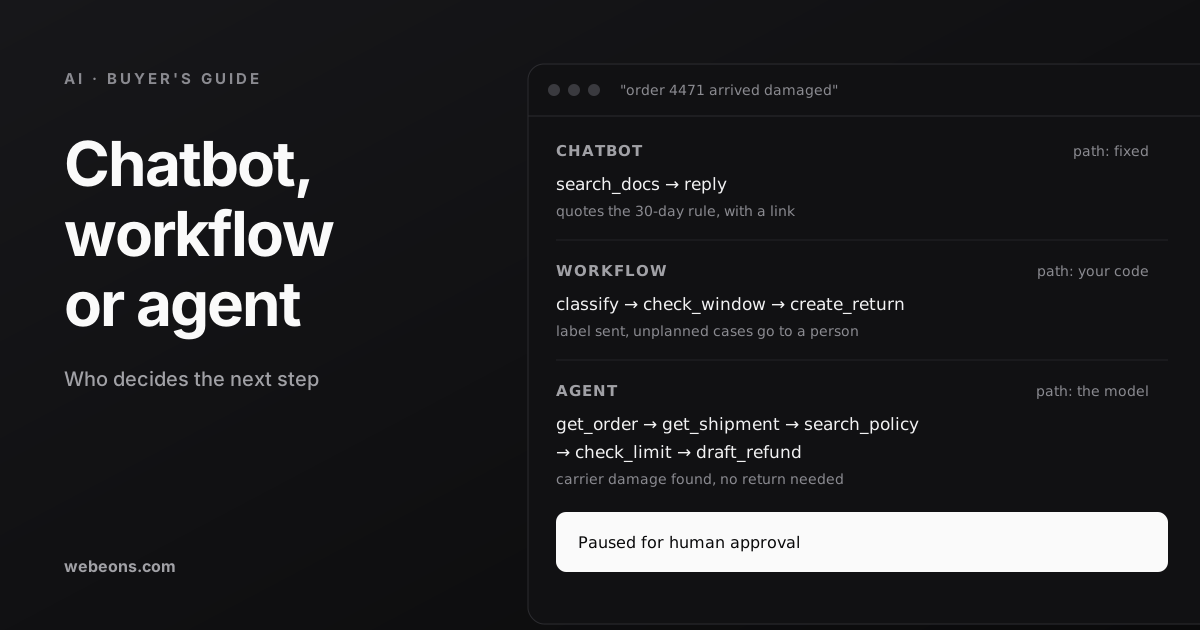
The word is being stretched. Gartner calls it agent washing, where vendors relabel chatbots and automation tools, and estimates that only about 130 of the thousands of vendors in the field deliver on their claims. Anthropic's engineering guide draws the line that matters: in a workflow, your code sets the path. In an agent, the model decides the next step and which tool to use.
Each decision you hand to the model is one more thing that can go wrong, so each step up this ladder needs more testing, tighter limits and better monitoring. The same guide advises looking for the simplest solution that works, and notes that many applications need only a single well-tuned model call with retrieval.
What It Costs to Build
These are published figures from agencies that sell this work, ourselves included, so read them as asking prices. They differ by several multiples because nobody can price an agent without seeing its scope.
What Actually Moves the Price
- Systems it touches. Reading one help center is easy. Reading and writing across a CRM, billing and orders means authentication, retries and failure handling for each.
- Whether it acts or suggests. An agent that drafts a refund for a person to approve is far cheaper to make safe than one that issues it.
- The cost of a wrong answer. In AskOrac, our own chatbot platform, we chose "I don't have that" over a guess: below a confidence gate, the fallback message goes out. That costs some coverage, and for product content it is the right trade.
- The state of your data. Outdated, contradictory documents produce confident wrong answers. Cleaning them is often the largest unbudgeted task.
- How you measure quality. For BlurbBio, our AI writing platform, we keep answer keys for test manuscripts, including a control book with planted errors. A check goes live only when it passes. Budget for your own version of this, because it is what lets you change a prompt without fear.
What It Costs to Run: Watch One Task
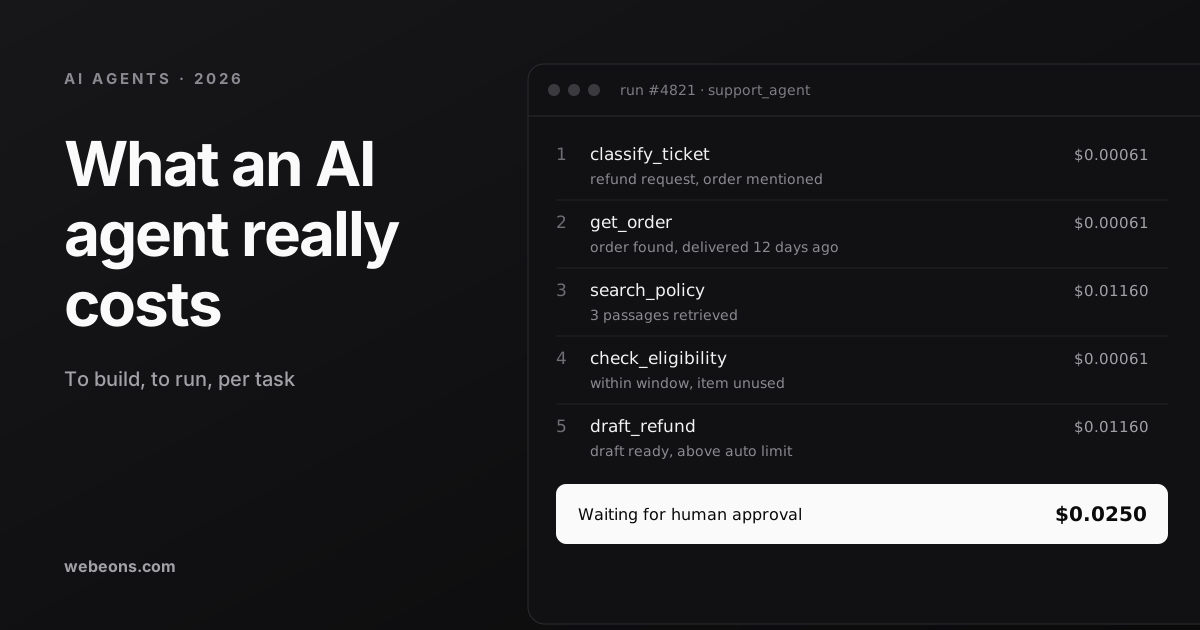
Agents bill by the loop. One user request becomes several model calls, and each call resends instructions, tool definitions and context. Here is an illustrative refund task, with the last step stopping for a person because the refund is over the agent's limit. Switch between the two setups to see the same work at different prices.
A cost of 2.5 cents looks like nothing until you multiply it. Try your own numbers below. The defaults reproduce the example: 10,000 tasks at five calls each gives $1,150 a month with no optimization, $580 with prompt caching, and about $250 with simple steps on the cheaper model.
That is a 4.6× swing for identical work, which is why we choose models by role. In BlurbBio a cheaper model does the bulk reading and a stronger one judges candidates, with one configuration per service so a model can be swapped and every evaluation re-run. It adds moving parts, and every model change means re-measuring. You also need a hard limit on steps and spend for each run, because a looping agent will happily burn a month's budget overnight.
The Costs Missing From Most Quotes
Model fees are rarely the biggest monthly line. Biz4Group puts maintenance at 15–20% of the build cost per year, and lists hosting at $300–$2,000+ a month on top. Three costs catch teams out most often:
- Long jobs outlive requests. In BlurbBio a request can time out while the job behind it keeps running, which left credits held for work the author never saw. We now reserve against a ledger key, commit only on delivery, and sweep anything left open. If your agent bills customers, you will need something similar.
- Latency has to be traced, not guessed. AskOrac's traces showed vector search at a 2,087 ms median. A pgvector iterative scan fixed the filtered search, and the slowest stage turned out to be the model call. Without per-stage timing we would have tuned the wrong thing.
- Providers retire models. OpenAI notified developers on 14 October 2026 that GPT-4o shuts down on 14 January 2027. Every model change means a round of re-testing, so plan for it each year.
Buy or Build?
Do this sum before commissioning anything. Fin, the AI agent from the company formerly known as Intercom, charges $0.99 per outcome, so 5,000 resolved conversations a month is $4,950. That buys a maintained product, which is a fair deal for standard support on a standard help desk. A custom build earns its place when your volume is high, when the agent must act inside your own systems, or when per-outcome pricing would punish your growth.
Why Agent Projects Get Canceled
Gartner predicted in 2025 that over 40% of agentic AI projects will be canceled by the end of 2027, citing escalating costs, unclear business value and inadequate risk controls. All three are decided before anyone writes code, so we would start like this:
- Pick one task with a measurable cost today, in hours per week or cost per ticket.
- Collect 50 to 100 real examples with the correct answer for each. That becomes your test set.
- Build the simplest version that could pass, and add autonomy only where results justify it.
- Start with a person approving every action. Widen permissions as the agent earns trust.
- Agree a kill rule up front: the accuracy and cost per task it must hit, and by what date.
Where This Is Heading
Three shifts will change these numbers over the next two years, and all three are visible now.
- Tokens keep getting cheaper at the low end. Anthropic lists Haiku 5.5 at a tenth of Haiku 4.5's prices. More steps become affordable, so the design question moves from "can we afford this call?" to "can we verify it?"
- Pricing is moving to outcomes. Fin already charges per resolution. Expect buyers to ask vendors, and internal teams, for cost per finished task rather than cost per token.
- Evaluation becomes the real asset. Models will keep changing on the provider's schedule. The team with a good test set can swap a model in a day. The team without one is guessing each time.
The practical conclusion: spend your budget on the test set, the permissions and the monitoring, because those last longer than any model.
Get a Straight Answer on Your Project
Tell us the task, your rough monthly volume and the systems involved, and we will say which level fits and what we would expect it to cost. If an off-the-shelf tool, or our own AskOrac, would do the job, we will tell you. Our AI integration service covers the full build, and our practical guide to AI integration is a good next read.
Sources (7)
Common questions
How much does a simple AI agent cost to build?
Agencies publish simple agents from about $20,000 to $35,000. Our custom AI chatbot builds, which sit at the retrieval level, are listed at $15,000 to $40,000. An off-the-shelf tool may cost far less if it fits your workflow.
How much does an AI agent cost per month to run?
It depends on volume, model calls per task and context size. In our worked example of 10,000 tasks at five calls each, model fees range from $1,150 to about $250 a month depending on caching and routing. Hosting, monitoring and maintenance come on top.
Is it cheaper to buy an AI agent or build one?
For standard support on a standard help desk, buying is usually cheaper. Fin charges $0.99 per outcome, so 5,000 resolutions cost $4,950 a month. Custom builds make sense at high volume, or when the agent must act inside your own systems.
How long does it take to build an AI agent?
Biz4Group publishes 4 to 6 weeks for simple agents and 10 to 14 weeks for advanced workflow agents. Our AI chatbot builds typically take 3 to 4 weeks from kickoff to production.
Know your agent's real cost before you build
Send us the task, your monthly volume and the systems involved. We'll tell you which level fits, what it should cost, and whether you should buy instead.