AI Chatbot Cost for a Website: 2026 Prices Compared
Vendors charge per reply, per seat or per resolution, so their prices rarely compare. Here is what Fin, Zendesk, Tidio, Chatbase and others charge today, what each one counts, and a calculator that shows where the lines cross.
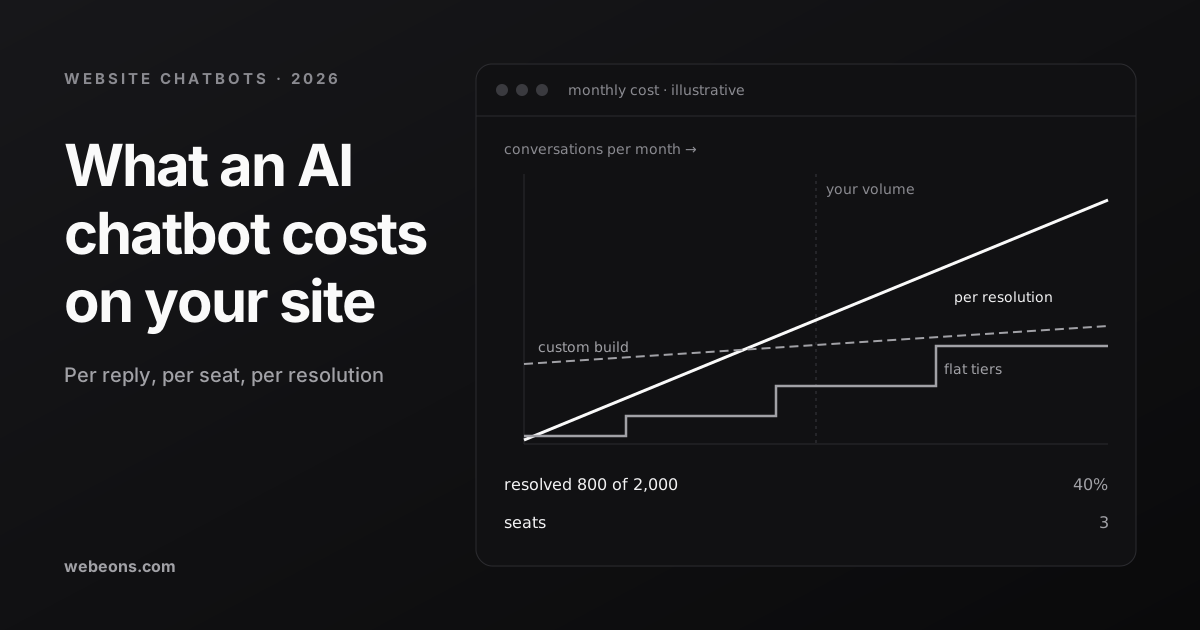
An AI chatbot for a website costs anywhere from nothing to tens of thousands of dollars, and the published prices are hard to compare because vendors meter different things. One charges per reply, another per resolved conversation, a third per seat. So the useful question is what your own traffic would cost on each model. Below are the prices as they stand today, what each vendor counts, and a calculator that shows where the lines cross. If you are still deciding whether a chatbot is the right tool at all, start with chatbot vs AI agent. For agents that act inside your systems, read our AI agent cost guide. This post is about chat on a website.
AI Chatbot Prices in 2026
We read each vendor's pricing page on October 31, 2026. Disclosure: AskOrac is our product, so weigh that row accordingly.
| Tool | Model | Entry price | What you get |
|---|---|---|---|
| tawk.to | Free, AI add-on | $0. AI Assist from $29 | Free live chat. Limited free AI for low volume |
| Tidio | Tiers plus AI quota | $0, then $24.17 | 50 Lyro conversations once. Lyro alone from $32.50 for 50 |
| Crisp | Flat per workspace | $0, then $45 | Mini has 4 agents and about 90 automated conversations. Free has no AI credits |
| Chatbase | Message credits | $32 | 700 credits, then $120 for 4,000 and $400 for 15,000 |
| AskOrac (ours) | Flat message tiers | $0, then $29 | 50 messages free. Pro 2,000, Business 10,000 at $79. No limit with your own API key |
| Fin | Per outcome | $0.99 an outcome | On your own help desk, 50 outcome minimum. On Intercom, plus $19 a seat |
| Zendesk AI agents | Seat plus resolutions | $19 a seat | 5 included per agent on Team plans. $1.50 committed, $2.00 pay as you go |
AskOrac's limits are worth stating plainly: only the website widget is live, with no voice or other channels yet. If you need those, one of the bigger vendors is a better fit today.
The Four Ways Vendors Charge
- Free tools. Good for a trial or a very quiet site. The limits are low, and Tidio's 50 Lyro conversations are a one-off allowance. You usually keep the vendor's branding.
- Flat tiers. A fixed monthly price for a number of messages or credits. Easy to budget, and you pay the same for a reply that helped and one that did not. When your allowance runs out, the service matters: Chatbase's FAQ says visitors then see a message that the agent is unavailable, unless you have set up auto-recharge.
- Per resolution. You pay when the bot finishes the job. The vendor's incentive lines up with yours, but your bill grows as the bot improves, and a traffic spike becomes a cost spike. We noted this problem when designing AskOrac: per-resolution pricing makes the monthly bill hard to predict.
- Custom. You pay to build it, then for upkeep and model usage. Our listed AI chatbot range is $15,000 to $40,000. You own the behavior and you carry the maintenance.
What Counts as a Resolution
This is where per-resolution quotes stop being comparable. Read the definition before you read the price, because a looser definition means a bigger bill for the same conversations.
| Vendor | Billing unit | The detail to check |
|---|---|---|
| Fin | Outcome | One per conversation. Resolutions, procedure handoffs, disqualifications and self-serve routings are $0.99. Lead qualifications are $9.99. No charge if a chat reaches your team without an outcome |
| Zendesk | Verified resolution | Since May 18, 2026, a model checks whether the request was resolved. Handoffs to a person and failed checks do not count. On messaging, a conversation ends 2 hours after the first message by default |
| Tidio | Lyro conversation quota | Its FAQ calls an interaction resolved when the customer sees it as successful and needs no follow-up within 15 minutes |
| Chatbase | Message credit | Credits per reply depend on the model: 1 on most, 2 on many newer ones, 4 or 5 on the strongest. An agent using actions costs more |
Fin's list matters most. An outcome is wider than a resolved question, so a calculation based only on your resolution rate may undercount. Zendesk's 2-hour default raises a different question: what happens when a customer comes back on the third hour? Ask each vendor for a month of sample billing data on real conversations before you commit.
One more caution on rates. We have not found a neutral, cross-vendor resolution rate we would quote, so the 40% we use below is a placeholder. Replace it with a figure from your own trial.
Compare the Cost on Your Own Traffic
Move the sliders. Each line uses the published prices above and the assumptions listed under the result. Watch two things: the per-resolution lines tilt upward with every resolved conversation, and the flat lines climb in steps as you cross a plan limit.
The defaults land at $79 on AskOrac, $280 on Chatbase, $849 on Fin with Intercom, about $1,400 for a custom build and $1,627 on Zendesk. Do not read that as a ranking. Fin and Zendesk include a help desk for your staff, and the other two bill you for every reply, whether it solved anything or not.
Hidden Costs of a Website Chatbot
- Branding removal. Chatbase lists it at $99 a month, about three times its entry plan. tawk.to lists $29 a month.
- Extra bots and storage. Chatbase charges $25 a month per extra agent and $25 per extra 10 MB. A site with two brands needs two.
- Stronger models. A model that costs 2 credits doubles your message bill on the same traffic. Test which one you need before you assume the plan fits.
- Content upkeep. A bot is only as good as what it reads. Someone has to fix the pages it answers from. This is staff time on every plan, and it never appears on an invoice.
- Handoff staffing. Unresolved chats go to a person. If no one answers, the chatbot has made a promise you cannot keep.
- Wrong answers. Our chatbot vs agent guide covers the Air Canada ruling, where the business was held to what its bot said.
- Disclosure. Goodwin reports that since August 2, 2026, EU transparency rules require that people interacting with AI systems such as chatbots are clearly informed, unless it is obvious from context. It cites fines of up to €15 million or 3% of worldwide turnover. If you serve EU customers, label the bot and take legal advice on your role.
What Running AskOrac Taught Us About Cost
We build and run AskOrac, so here is what we see from the other side of the invoice. Three choices affect what a buyer really pays, on any platform.
The first is what happens at the edge of the bot's knowledge. In AskOrac's strict mode, a raised retrieval threshold and a confidence gate send the project's fallback message in place of an improvised answer. Coverage drops. On per-resolution pricing, a plain handoff may cost nothing while a confident wrong answer may be billed as a success. So check how a vendor's verification treats a wrong answer that the customer simply accepts.
The second is freshness. AskOrac re-syncs on a 24-hour cycle and re-processes only content that changed, because outdated pages produce outdated answers. Ask any vendor how often it re-reads your site and whether that is included.
The third is what you learn. AskOrac finds knowledge gaps from real questions and drafts answers for an owner to review. That loop is how a resolution rate rises, so check that your vendor shows you the questions it failed on.
When a Custom Chatbot Is Worth It
On the default inputs, the calculator shows Fin passing a custom build at about 3,600 conversations a month. Treat that as a signal to look closer, because cost is rarely the deciding reason. We would only suggest custom when one of these holds:
- The bot must read private systems or follow rules a hosted tool cannot express.
- Data handling rules prevent you from using a shared service.
- The chat sits inside your product, and its behavior is part of what you sell.
If none of those applies, buy a tool. For standard questions on a standard website, paying $15,000 to avoid a $79 subscription makes no sense, even though we sell the $15,000 option. Run a trial for a month and use those real numbers in the calculator.
Where This Is Heading
- Verification is entering the invoice. Zendesk's May 18, 2026, tiers use a model to decide whether a resolution counts. Expect more vendors to define billing by a checked outcome, and expect disputes about how the check works.
- Disclosure is enforceable. The EU transparency provisions became enforceable on August 2, 2026, which makes a clear AI label part of the cost of serving EU customers.
- Model changes reach your bill. OpenAI gave notice on October 14, 2026, that gpt-4o and gpt-4o-mini leave its API on January 14, 2027. Chatbase's table already charges more credits for many newer models. When a vendor moves you to a new model, the same traffic can cost more.
Pick the Model That Matches Your Traffic
Start with a free or flat plan, measure your own resolution rate for a month, and then run the numbers again. Per-resolution pricing suits a business that already has a help desk and wants to pay for results. If you want a second opinion, send us your volumes and we will tell you which option fits, including when it is someone else's product. When hosted tools cannot do the job, our AI chatbot solution covers custom builds.
Sources (14)
Common questions
How much does an AI chatbot for a website cost?
On pages read October 31, 2026, flat plans run from free to about $100 a month for small sites, with Chatbase from $32, Crisp from $45 and AskOrac from $29. Fin charges $0.99 per outcome, and Zendesk $1.50 to $2.00 per resolution. A custom build from us is listed at $15,000 to $40,000.
What is per-resolution chatbot pricing?
You pay when the bot completes a conversation, rather than for each message or a flat fee. Definitions vary. Fin bills one outcome per conversation and counts some handoffs and routings. Zendesk counts a resolution when a model verifies the request was resolved.
Is a free AI chatbot good enough?
For a trial or a quiet site, it can be. Limits are low: Tidio's free tier has 50 Lyro conversations once, AskOrac's free plan has 50 messages a month, and Crisp's free plan has no AI credits.
When should I build a custom chatbot?
When the bot must read private systems, when data rules prevent a shared service, or when the chat is part of your product. If none of those applies, a hosted tool is usually the better choice.
Do I have to tell visitors they are talking to a chatbot?
If you serve EU customers, take this seriously. Goodwin reports that EU AI Act transparency provisions became enforceable on August 2, 2026, and require that people are clearly informed they are dealing with an AI system unless it is obvious from context. Take legal advice on your role.
Which chatbot pricing fits your traffic?
Send us your monthly conversations, your help desk and what the bot must answer. We'll tell you which option costs least, even if it isn't ours.