Custom Software Development Cost in 2026: Rates and Estimates
Custom software costs effort times rate. Here is how an estimate is built, what developers earn and firms list per hour, how to compare quotes, and a tool to price your own system line by line.
If you are pricing an internal system, a customer portal or a workflow tool, you need a number you can defend to a budget owner. That number is effort multiplied by a rate, and almost every argument about price comes down to one of those two. This guide shows how an estimate is built, what moves it, what rates look like as of October 2026, and how to compare quotes that seem incomparable.
We sell this work, so weigh our view accordingly. If you are still deciding whether to build at all, start with our custom software vs SaaS guide. If you are selling software to customers, our SaaS cost guide fits better. If you are choosing what goes in a first version, read our MVP cost guide.
How Much Does Custom Software Cost?
No neutral price list exists. The closest thing to market data we found is Clutch, a review marketplace. Its guide for software development, updated September 21, 2026, gives a typical reviewed project of $10,000 to $49,999, an average project cost of $132,480, and a usual timeline of about 13 months. The typical band and the average sit far apart, which suggests that a few large projects pull the average up. Clutch does not state its sample size, and buyers who leave reviews are not a random group.
We do not list a price for internal systems. Our nearest listed ranges are SaaS MVPs at $40,000 to $80,000 and full SaaS platforms at $80,000 to $200,000+. An internal tool drops billing and public sign-up, and it often adds integrations and old data, so those ranges are a loose guide.
How an Estimate Is Built
A sound estimate is a list of work with assumptions attached. We build ours in five steps, and you should expect something similar from any vendor:
- Split the system into modules. A module is one area of work, such as orders, approvals or reporting.
- Size each module as a range. A low and a high figure in person-weeks says how much is still unknown.
- Add the work between modules. Roles, integrations, data migration and compliance often cost more than any single screen.
- Add testing and project management. A quote without these has moved them to your staff.
- Multiply by the rate. This comes last, because a rate means nothing until you know the hours.
The range matters as much as the middle. In software, estimates made before requirements are gathered are generally uncertain by a factor of four in either direction, a figure attributed to Barry Boehm's 1981 work and later popularized as the cone of uncertainty. Boehm's first numbers were a judgment call, and later research supported the shape. It does not narrow by itself. It narrows when someone does the discovery work, which is why a short paid discovery is usually the best money in the project.
Custom Software Development Rates in 2026
There are two kinds of rate here: what a developer earns, and what a firm bills. The first has good public data. The second has mostly self-reported listings.
The Bureau of Labor Statistics put median pay at $135,980 in May 2025, with the lowest 10% under $82,460 and the highest 10% above $214,670. Developers in computer systems design, the industry that includes many software firms, had a median of $132,050. Benefits were 30% of private-industry compensation in June 2026, so a median US developer costs an employer roughly $93 an hour before office, tools or management.
Now compare Clutch's US band of $50 to $99. Much of it sits below what a median US employee costs. Clutch does not explain this, and we would not guess. It is a good reason to ask every vendor who will do the work, where they sit, and how senior they are. The $75 default in our estimator below is a placeholder and not our rate, so set your own.
Estimate Your Project
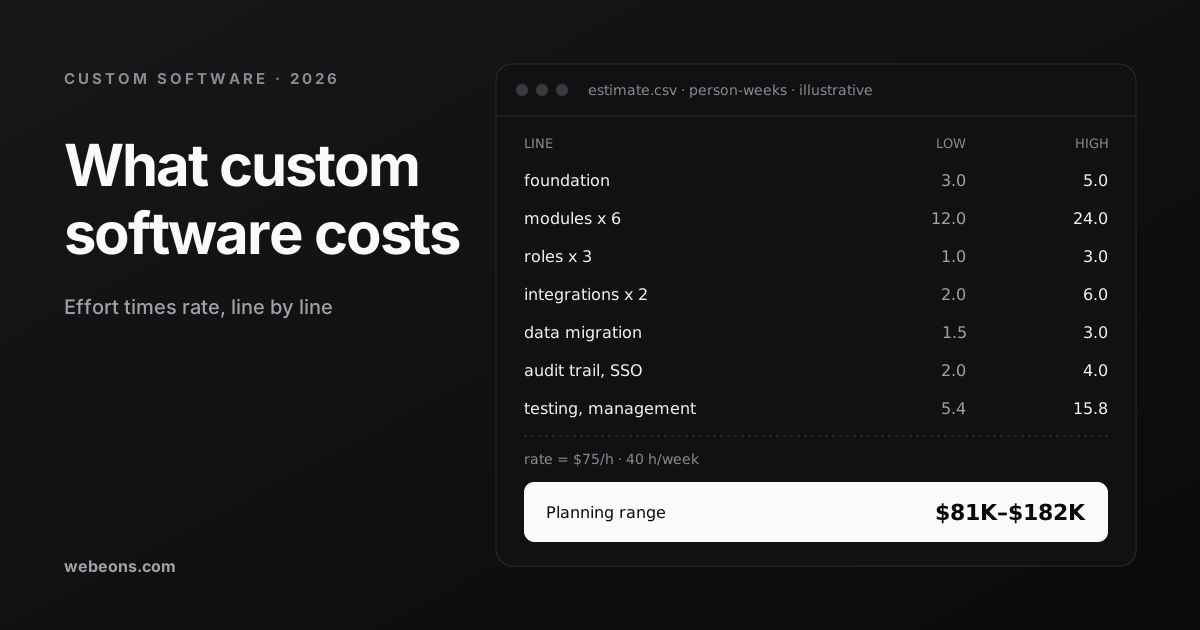
List your modules, then set the rate from a real quote or your own payroll. The range covers the build only. Effort per line is our judgment, drawn from how this work tends to go. It is not a study. We chose the defaults to resemble a mid-sized internal system, and they land near Clutch's average, so that match proves little.
The range is narrower than the cone of uncertainty because you have already listed your modules. If that list is a guess, widen it yourself.
What Moves the Number Most
Take the default in the tool, an illustrative system with six modules, three roles and two integrations. Each module adds $7,500 to $16,200 at $75 an hour, so scope is the most direct lever. Four other things move the total more than buyers expect.
Data migration. Moving from one clean source to several messy ones adds $9,400 to $28,400 in the tool. Old data carries decisions nobody wrote down. When we moved book details on The Bookish Elf from free text into linked data, across about 3,000 reviews, 478 publisher spellings became 413 clean pages. Merging took judgment, and we kept imprints separate because merging them would have been wrong for readers. A later migration quietly removed internal links and orphaned posts we had already fixed, so orphans are now recounted after any migration. Budget for checking the result as well as moving it.
Integrations. The other system sets the pace. Ask for its documentation, a test environment and a named contact before accepting any estimate. We use a range of one to three person-weeks each, and an old system with no test environment can pass the top of that.
Roles and approvals. Every extra role multiplies what must be tested, because each screen now has more than one correct behavior. Write down who can see, change and approve what before you ask for quotes.
Compliance. Moving from an audit trail to regulated data adds $15,000 to $32,400 in engineering in the tool, and the audit is a separate bill. Drata, which sells compliance software, gave SOC 2 Type 2 auditor fees of $12,000 to $20,000 for small to midsize companies in March 2026, and first-year totals from $25,000 to over $200,000. These are vendor estimates.
One more driver hides in plain sight: long-running work. In BlurbBio, an AI writing platform we built, reading a whole novel takes many minutes, so that work runs in separate job services. The cost is two deploy surfaces, and some releases have to go out in a set order. If your system runs large imports or overnight reconciliation, say so early, because it changes the architecture.
How to Compare Quotes
Two quotes for the same list rarely describe the same work. Convert them to one scope before you compare the totals.
| Line | Quote A | Quote B |
|---|---|---|
| Stated total | $60,000 | $90,000 |
| Hours and rate | 1,500 h at $40 | 1,000 h at $90 |
| Data migration, 200 h | Excluded, +$8,000 | Included |
| Testing, 400 h | "Your team", +$16,000 | Included |
| Post-launch support, 100 h | Excluded, +$4,000 | Included |
| Same-scope total | $88,000 | $90,000 |
Ask every vendor for the same six things: hours by role, named assumptions, what is excluded, how changes are priced, who owns the code, and what happens after launch. Be wary of a single figure with no assumptions, and of a very short estimate for a system nobody has examined. Our buyer's guide covers the rest of the vetting.
Plan for overruns too, and deliver in slices. The best-known data comes from McKinsey and the University of Oxford, published in 2012, covering more than 5,400 IT projects.
The same research reported that each extra year of duration raised overruns by 15%. That is the argument for releasing a useful piece every few months, so you can stop or change course with something working in hand. We would hold about 25% as contingency on a project of this size. That is our judgment, and the discovery phase should tell you whether it can come down.
What Custom Software Costs After Launch
Finance teams often approve the build and forget the rest. We plan upkeep at 15% to 20% of the build each year, for security patches, dependency updates, small changes and bug fixes. That is a planning assumption and not a measured figure, and a system that changes often will cost more. At the far end of the scale, US federal agencies report spending about 80% of their $100 billion-plus yearly IT budget on operating and maintaining existing systems, per the GAO in July 2025. Your ratio will differ, but the direction is the same.
| Cost | Year 1 | Year 2 | Year 3 |
|---|---|---|---|
| Build | $130,000 | – | – |
| Upkeep | – | $26,000 | $26,000 |
| Hosting and paid services | $6,000 | $6,000 | $6,000 |
| Total, $200,000 over three years | $136,000 | $32,000 | $32,000 |
Count your own people as well. Someone has to answer questions during the build, test the result, and own the system afterward. If nobody can take that on, the project will stall whatever the quote says. Our agency vs in-house guide looks at who should hold that work.
Where This Is Heading
- Accounting for internal software is changing. The FASB issued ASU 2025-06 on September 18, 2025. It removes the project-stage model. Costs are capitalized once management has committed funding and completion is probable, unless significant development uncertainty remains. It applies to annual periods beginning after December 15, 2027, with early adoption permitted. A clear estimate and scope may soon help your auditors as well as your budget. Ask your accountant how it applies.
- The US tax treatment now depends on where work happens. Under Section 174A, domestic research costs, which include software development, can be deducted immediately for tax years beginning after December 31, 2024. Foreign research costs must still be amortized over 15 years. That can narrow the gap on offshore rates. Our working hours are GMT+5:30, so weigh that point against our interest, and ask your tax adviser how your contract is treated.
- AI savings are still hard to price. METR's February 2026 update found late-2025 point estimates of 18% and 4% speedups, with intervals that cross zero. METR itself calls the data very weak evidence, because developers increasingly refused to work without AI. Ask each vendor what AI changes in its estimate, and which lines it left alone.
Before You Ask for a Price
Write your module list, count your roles, name every system it must connect to, and look at the data you plan to move. Then take the same list to two or three vendors. Our backend and API team does most of this work, and our SaaS development page shows how we run a build from discovery to launch. If you want a second opinion, send us your list. We will tell you which lines look wrong, including when a product you can buy would do the job.
Sources (10)
Common questions
How much does custom software development cost in 2026?
It depends on effort and rate. Clutch reports a typical reviewed project of $10,000 to $49,999 and an average of $132,480, updated September 2026. Our illustrative internal system comes to $81,000 to $182,000 at $75 an hour, and effort in that figure is our judgment.
What are custom software development rates?
Clutch lists average bands of $25 to $49 an hour for India, the Philippines, Ukraine and Mexico, $50 to $99 for the US, Poland and Spain, and $100 to $149 for Canada and Australia. For comparison, the median US software developer earned $135,980 in May 2025, about $65 an hour in wages.
How do I compare two software development quotes?
Convert them to one scope first. Ask each vendor for hours by role, assumptions, exclusions, how changes are priced, who owns the code, and what happens after launch. Then price anything one quote leaves out at that vendor's own rate.
How much does custom software cost to maintain?
We plan 15% to 20% of the build each year for patches, updates, small changes and fixes. That is a planning assumption, not a measured figure, and a system that changes often will cost more. Add hosting, paid services and your own staff time.
Why do software projects go over budget?
Early estimates carry real uncertainty, and work such as data migration and integrations is often underestimated. McKinsey and the University of Oxford reported in 2012 that large IT projects, those above $15 million, averaged 45% over budget. That data is old and applies to large projects only.
Pricing an internal system?
Send us your module list, roles and the systems it must connect to. We'll tell you which lines look wrong and what we would check first, including when a product you can buy would do the job.