Why AI Projects Fail: What RAND, MIT, McKinsey and Gartner Measured
The 80%, 85% and 95% figures measure different things. Here is what each study really found, the causes that hold up, and a pre-mortem for your own project.
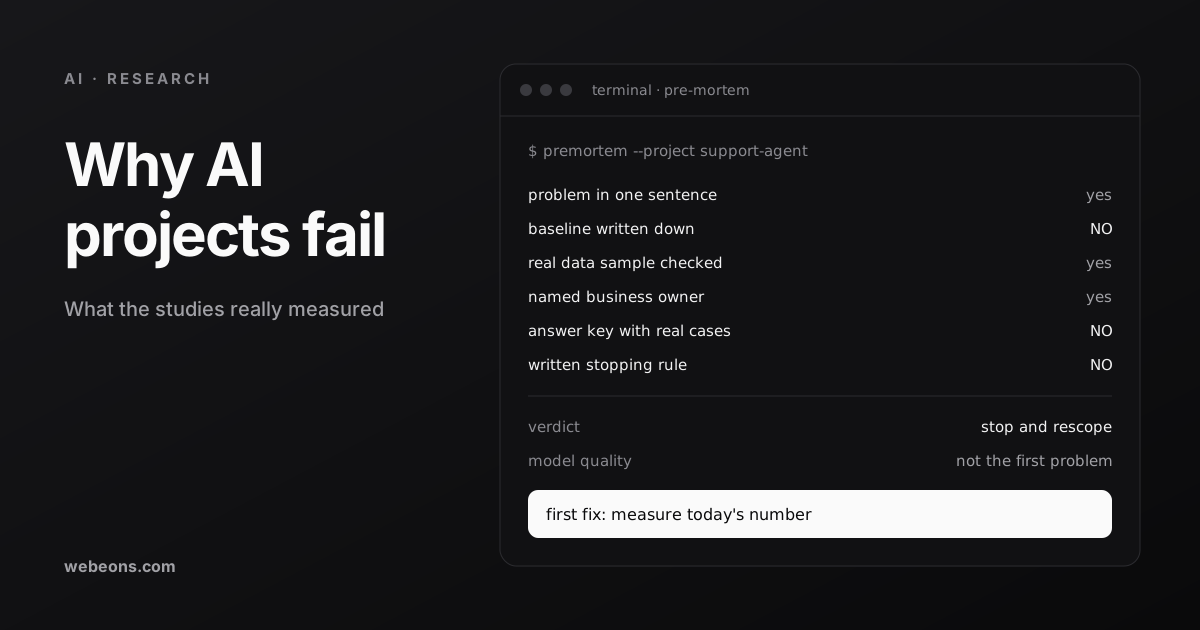
If your AI project is at risk, the cause is probably not the model. RAND, McKinsey and Gartner all point the same way: projects stall on the problem definition, the data, the workflow and the decision nobody wants to make, which is when to stop. Those are fixable, and most of them can be checked in a week.
First, though, the numbers. Boards quote 80%, 85% and 95% as if they measure one thing. They do not, and a decision resting on a misread statistic is a poor start. Below is what each study really measured, the causes that survive scrutiny, and a pre-mortem you can run on your own project today.
What Each Study Actually Measured
These reports ask different questions of different people. A forecast, an interview study and an executive survey cannot be averaged into one failure rate.
| Source | Figure | What it measures | Base |
|---|---|---|---|
| RAND, August 2024 | More than 80% fail | An outside estimate RAND cites. Its own work is on causes | 65 experienced data scientists and engineers, interviewed |
| MIT NANDA, July 2025 | 95% see no return | Marked, sustained impact from task-specific tools | 52 organizations, 153 survey responses, 300+ public initiatives |
| McKinsey, August 2026 | 37% report EBIT impact, 6% are high performers | Self-reported financial impact | 1,719 respondents in 97 countries, May 4 to June 8, 2026 |
| Gartner, October 2026 | 13% report significant value | CIO perception of value | 2,002 CIOs and technology executives, May to July 2026 |
| Gartner, June 2025 | Over 40% of agentic projects canceled by end of 2027 | A forecast | Analyst prediction |
RAND. RAND's report is the most useful of these for anyone running a project, and the most misquoted. Its authors interviewed 65 people with at least five years of experience building AI models. The 80% is framed as "by some estimates", described as about twice the failure rate of IT projects without AI. RAND did not measure it. What RAND offers is an account of why projects go wrong.
The "85% fail" line. Trace this one and it falls apart. Gartner's February 13, 2018 release predicted that through 2022, 85% of AI projects would "deliver erroneous outcomes" because of bias in data, algorithms or the teams managing them. That was a forecast about wrong outputs, made in 2018. It was never a measured failure rate, so do not put it in a board paper.
McKinsey. The 2026 survey is a self-report, since these are respondents describing their own organizations. It found that 44% say AI is scaling across the enterprise, up from 38%, while EBIT impact stayed flat at 37%. So use is growing faster than money. That gap is the real story, and it is a different claim from "AI fails". Eighty percent report better individual productivity, and that gain has not reached the income statement for most.
Gartner. Gartner's October 19, 2026 release says the likelihood of a use case succeeding is about one in five. It also says that 13% of CIOs report significant or transformational value. These are different measures. The 13% does not mean the other 87% got nothing.
The MIT 95% Figure, Fairly
The MIT NANDA report, The GenAI Divide: State of AI in Business 2025, spooked investors in August 2025, and it is worth reading carefully rather than repeating or dismissing it.
Here is what weakens the headline. The report is marked as preliminary findings, and critics say it calls its own figures "directionally accurate", based on interviews rather than company reporting. Success was defined tightly: deployment beyond pilot with measurable KPIs, ROI measured six months after the pilot, and a "marked and sustained" productivity or P&L impact. A tool with modest real returns counts as a failure under that bar. Six months is also a short window.
The denominator is the bigger problem. Wharton's Kevin Werbach wrote that he could not find where the 95% comes from, and that the only 5% he could locate applies to custom enterprise tools. On the funnel above, 5 of the 20 who piloted is about a quarter, so some of the 95% are organizations that never ran a pilot. Researcher Ray Poynter makes the same point. Press coverage muddied things further: Fortune reported 150 interviews and a survey of 350 employees, while readers of the report cite 52 interviews and 153 leaders. The authors' project also builds agent infrastructure, which is the remedy the report favors. Fortune noted that interest and found no evidence that it skewed the results.
Now the fair part. None of that makes the report useless. Its central observation matches what we see: general tools such as ChatGPT spread easily and help individuals, while custom tools stall because they do not fit the workflow or learn from use. Treat it as a directional study of why pilots stall. It is no basis for saying 19 of 20 projects fail.
Why AI Projects Fail: The Causes That Hold Up
RAND's five root causes are the best starting list. Stakeholders misunderstand or miscommunicate the problem, and that was the most common cause. The organization lacks the data. The team chases the latest technology over the real problem. Infrastructure to manage data and deploy models is missing. Or AI is pointed at a problem too hard for it.
McKinsey's high performers show the other side. Nearly three-quarters report fundamentally redesigning workflows because of AI, against one-quarter of everyone else. They are twice as likely to have senior leaders committed to AI and defined processes to measure impact. This is correlation, and it comes from a small group of about 6% of respondents, but it agrees with RAND.
We group the causes into five areas, because each has a different owner and a different first fix.
- Problem. Nobody can say what success looks like, or what today's baseline is. If this is your gap, fix it before anything else.
- Data. The data is missing, restricted or worse than its description. Gartner predicted in February 2025 that organizations would abandon 60% of AI projects unsupported by AI-ready data through 2026. That is a forecast about one group, and it is often misquoted as all projects.
- Ownership. The project sits with a technical team while the business waits. Nobody will end it. This is where the Gartner stopping data bites.
- Evaluation. Quality is judged by a good demo. Without known right answers, you cannot tell a better version from a worse one.
- Cost. The unit cost was never worked out. One in five McKinsey respondents now says operating costs limit their AI use.
Run a Pre-Mortem on Your Project
A pre-mortem assumes the project has already failed and asks why. Answer these twelve questions honestly. Every answer starts at No, and a guess counts as No.
How We Handle This on BlurbBio
BlurbBio is an AI writing platform that we built to read whole novels. Its findings can be wrong in ways a writer cannot easily spot, so a feature stays unproven until it passes a measured test.
Answer keys. We keep gold-standard keys for test manuscripts, including a control book with deliberately planted errors. On a mutation test on a full-length novel, all three planted errors were caught with no false flags. In a manual spot-check, 50 of 51 canon findings were correct. Those numbers exist because the key exists.
Ship dark until a bar is met. A check goes live only when it passes. The cost is real: some finished features stay off. A subplot sweep for dropped threads is one of them, and it stays off until it clears its bar. We accept that, because authors stop trusting a tool that cries wolf.
Kill switches. Every risky change carries one. It is more code to maintain, and it means a bad result is an incident you can end in minutes, not a release you have to rush.
This is small-team discipline, and it scales down well. An answer key can be a spreadsheet of 50 real cases.
Why Agentic AI Projects Fail
Agents inherit all of this and add new ways to go wrong, because they act. Gartner's June 2025 forecast of over 40% canceled by the end of 2027 names escalating costs, unclear business value and inadequate risk controls. Its analyst called most projects early experiments driven by hype. It also estimated that only about 130 of thousands of vendors offer real agentic capability, and called the relabeling "agent washing". That is a prediction, so judge it as one.
Actual use is growing unevenly. McKinsey found 40% of respondents at large organizations scaling agents, up from 27%, and smaller organizations flat at 22%.
Our practical view: most failed agents should have been a simpler system. If a fixed workflow or a retrieval chatbot does the job, use it. Our guide to chatbots and AI agents shows how to tell, and what an AI agent costs to build and run gives the numbers that catch people out later.
Where This Is Heading
- Stopping rules are becoming a marker of good management. In Gartner's October 2026 data, 31% of CIOs have guidelines for when a pilot should not reach production, and 17% have them for abandoning low-value AI already live. Organizations with those rules were 2.3 and 2.6 times more likely to be in its top group. That is association, not proof, and the rules are cheap to write.
- Operating cost is now a design constraint. McKinsey's August 2026 survey found about one in five limiting use because of cost, while 60% expect to invest more next year.
- Workflow redesign is pulling ahead. The share of McKinsey high performers redesigning workflows rose from 55% to nearly three-quarters in a year.
- Building in-house is getting easier to justify. In the same survey, 32% decided against buying a software product or feature because agentic coding tools let them build it. Expect more internal projects, and more that need everything above.
What to Do First If Your Project Is at Risk
- Run the pre-mortem with the sponsor in the room, and take the No answers seriously.
- Write the one-sentence problem and today's baseline.
- Build a small answer key from real cases, then score the current version against it.
- Agree the result and date that would end the project.
- If the score and the business case both hold, narrow the scope and continue. If not, stop, and keep what you learned about your data.
Stopping is a legitimate outcome. Many AI projects should become a simpler automation, or nothing. If you want outside eyes, our AI integration team starts with exactly these checks. Or send us your pre-mortem result, and we will tell you what we would fix first, and whether we would continue at all.
Sources (16)
Common questions
What percentage of AI projects fail?
No study gives one reliable number. RAND cites estimates of more than 80%, MIT NANDA's disputed report says 95% see no return, and Gartner's October 2026 release puts a use case's likelihood of success at about one in five. Each measures something different.
Is the MIT 95% AI failure figure accurate?
Treat it as directional. The report is labeled preliminary, draws on 52 organizations plus 153 survey responses, and uses a tight definition of success. Wharton's Kevin Werbach said he could not find where the 95% comes from. Its point about tools that do not fit workflows is still useful.
Did Gartner say 85% of AI projects fail?
No. In February 2018 Gartner predicted that through 2022, 85% of AI projects would deliver erroneous outcomes because of bias in data, algorithms or the teams managing them. That was a forecast about wrong outputs, not a measured failure rate.
Why do AI projects fail?
RAND's most common cause is a misunderstood or miscommunicated problem. Others are missing data, chasing new technology, weak infrastructure and problems too hard for AI. McKinsey's high performers differ most by redesigning workflows and measuring impact.
Why do agentic AI projects fail?
Gartner's June 2025 forecast of over 40% canceled by the end of 2027 names escalating costs, unclear business value and inadequate risk controls. It is a prediction, not a measurement. In our view, many of these should have been a simpler workflow or chatbot.
Find out if your AI project should continue
Send us your pre-mortem result and where the project stands. We'll tell you the first risk we would fix, and whether we would keep going at all.