ADA Website Compliance in 2026: Deadlines, Lawsuits and What to Fix
The ADA website deadline you keep reading about applies to governments. Most businesses fall under Title III, with no date and real lawsuit risk. Here is who must do what, the 2025 lawsuit numbers, and a quick check. Not legal advice.
This is not legal advice. We build websites, and we are not lawyers. Webeons holds no legal, accessibility or compliance certification. This article quotes the Federal Register and the Department of Justice so you can read what they say. If you have received a demand letter, call a lawyer today.
The confusion starts with one word: deadline. Search "ADA website compliance deadline" and you will find dates that apply to cities and counties, presented to shop owners. Here is who really has a date, who does not but can still be sued, and what to fix first.
Who Has an ADA Website Deadline, and Who Does Not
The ADA splits the world into parts. Title II covers state and local government. Title III covers businesses open to the public, such as shops, restaurants, hotels, clinics and service firms. Only Title II has a web rule with dates.
| Who | What applies | Deadline |
|---|---|---|
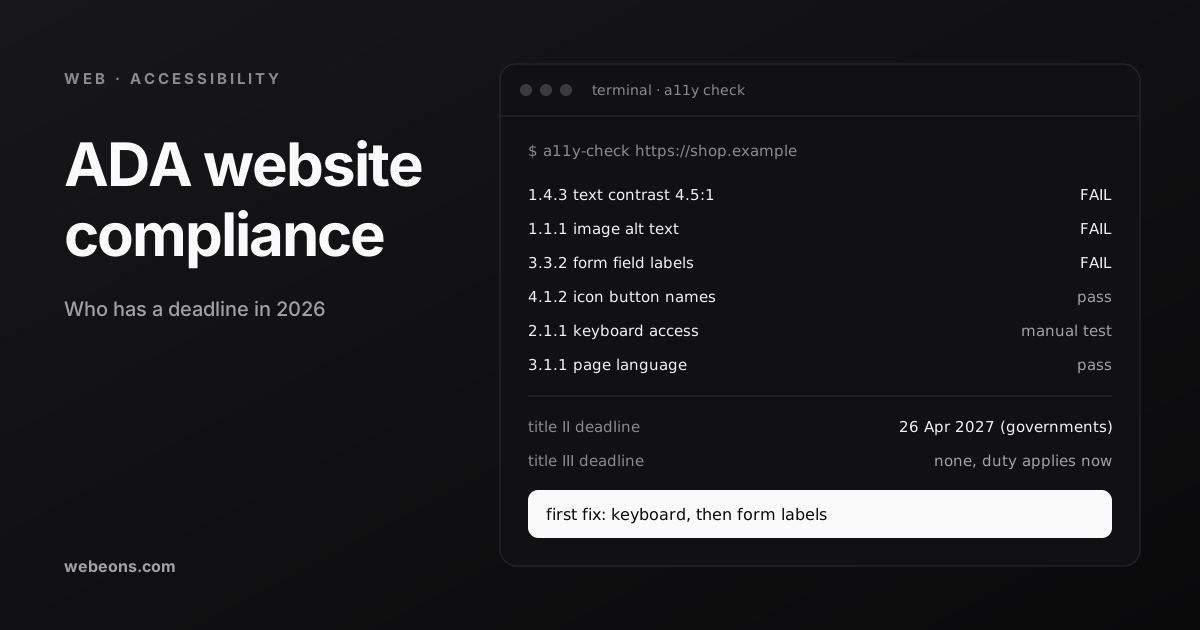
| State and local governments, population 50,000 or more | ADA Title II web rule | April 26, 2027 (was April 24, 2026) |
| State and local governments under 50,000, and special district governments | ADA Title II web rule | April 26, 2028 (was April 26, 2027) |
| Companies selling web content or apps to those governments | No rule on you directly | None, but the rule covers what governments provide "through contractual, licensing, or other arrangements" |
| Private businesses open to the public | ADA Title III, no web regulation | None. The general duty already applies |
The Title II Rule and the April 2026 Extension
On April 24, 2024, the DOJ published a final rule on the web content and mobile apps of state and local governments. It adopted WCAG 2.1 Level AA, published in June 2018, as the technical standard. It applies to content that public entities "provide or make available, directly or through contractual, licensing, or other arrangements". The original deadlines were April 24, 2026 for entities with a total population of 50,000 or more, and April 26, 2027 for smaller ones and special district governments.
On April 20, 2026, the DOJ published an interim final rule, effective the same day, which extended both dates by a year. Its summary says the date for the larger group "is extended from April 24, 2026, to April 26, 2027", and for the smaller group "from April 26, 2027, to April 26, 2028". Comments closed on June 22, 2026. The topic notes we started from had the 2027 date right, and the Federal Register confirms it.
Two lines in that notice matter for planning. First, it says the extension does not alter the substantive requirements of the 2024 rule. Second, the DOJ "plans to engage in future rulemaking processes related to the substantive requirements", and during the extension "will consider issuing an NPRM" on them. So the standard itself could change before 2027. We found nothing further in the Federal Register as of November 2026.
If you sell software or web services to a city, county, school district or transit agency, this is your deadline in practice. The rule binds them, and it covers what they provide through contracts, so expect WCAG 2.1 AA in their contracts and procurement questions.
ADA Website Compliance for Small Businesses: Title III
For private businesses there is no web regulation. In 2010 the DOJ started rulemaking on web accessibility under both titles. On December 26, 2017 it withdrew that notice, saying it "has not published any rulemaking document regarding title III Web accessibility since the 2010 ANPRM". Our search of the Federal Register found no Title III web rule since. The April 2026 notice confirms that the Title III regulations "are not addressed in this rulemaking".
No rule does not mean no duty. The DOJ's guidance on web accessibility, dated March 18, 2022 and still on ada.gov in November 2026 with no withdrawal notice, says that "Title III prohibits discrimination against people with disabilities by businesses open to the public". It also says businesses "have flexibility in how they comply", that the DOJ "does not have a regulation setting out detailed standards", and that WCAG and the Section 508 Standards provide "helpful guidance".
So a small business has no date to meet, and no safe harbor either. In practice, WCAG 2.1 AA is the reference point. It is what the federal rule for governments uses, and it gives you something concrete to test against.
ADA Website Lawsuits: What the Numbers Say
Lawsuit trackers disagree, mainly because some count federal court only and some add state courts. We use one that we could read in full: Seyfarth Shaw LLP, a law firm that defends businesses in these cases, which counts federal filings each year on its ADA Title III blog.
In 2025 Seyfarth counted 3,117 federal website accessibility suits, up 27% from 2,452 in 2024. They made up 36% of all federal Title III suits, 3,117 of 8,667. New York had 1,021, Florida 961 and Illinois 585. Other trackers that add state courts report higher totals, but we could not read their primary reports, so we do not quote them.
What a plaintiff can win matters too. A private Title III suit uses the remedies of 42 U.S.C. 2000a-3(a), which is a civil action for preventive relief such as an injunction, and the ADA lets a court award the winner a reasonable attorney's fee under 42 U.S.C. 12205. State laws can add more. Your lawyer will know which apply where you operate.
WCAG 2.1 AA in Practical Terms
WCAG 2.1 has 78 success criteria. Level AA means meeting the 30 at Level A and the 20 at Level AA, so 50 in all. Most sites fail the same handful. WebAIM, part of Utah State University, which also sells accessibility training and testing, runs automated tests on the top 1,000,000 home pages each year.
The six most common failures it found were low contrast text on 83.9% of home pages, missing image alt text on 53.1%, missing form labels on 51%, empty links on 46.3%, empty buttons on 30.6%, and a missing page language on 13.5%. Almost all of these are cheap to fix in code.
<!-- before -->
<html>
<img src="team.jpg">
<input placeholder="Email">
<button><svg>...</svg></button>

<!-- after -->
<html lang="en">
<img src="team.jpg" alt="Our four support staff at the front desk">
<label for="email">Email</label>
<input id="email" type="email" autocomplete="email">
<button aria-label="Search"><svg aria-hidden="true">...</svg></button>
Automated tools find these. They cannot judge whether alt text is useful, whether the focus order makes sense, or whether a checkout can be finished by keyboard. That takes a person, ideally with a screen reader such as VoiceOver or NVDA.
Run a Quick Accessibility Check
Twelve common checks, each tied to a WCAG 2.1 criterion. Open your site in another tab and answer honestly. Not sure counts as not passing.
Accessibility Overlays and Widgets: What the FTC Found
An overlay is a script that adds a toolbar or tries to repair a page automatically. Many are sold as a fast route to compliance. We will only say what a primary source supports.
In January 2025, the Federal Trade Commission announced an order requiring accessiBe to pay $1 million over claims that its AI-powered tool could make any website WCAG-compliant. The complaint alleged that accessWidget "did not make all user websites WCAG-compliant". The FTC approved the final order on April 22, 2025. It bars the company from claiming its automated products can make any website WCAG-compliant without evidence. The FTC's consumer protection director said that "overstating a product's AI or other capabilities without adequate evidence is deceptive".
That is a ruling about one vendor's advertising, not about every widget. The practical lesson still holds. A script loaded on top of your page cannot rewrite every unlabeled form, unnamed button or inaccessible checkout underneath it. Fix the source.
How We Handle Accessibility in Our Own Work
The hardest case is code that runs on websites you do not control. AskOrac, our AI support platform, ships as a chat widget that loads on customers' sites alongside unknown scripts, styles and ad blockers. We run its interface in an iframe, with message origins pinned and validated. And we wrote test protocols for platforms, mobile browsers, ad blockers and accessibility, because a failure there is a failure on a customer's site.
The lesson carries over to any site. Third-party widgets are part of your website as far as a visitor is concerned. Test chat, booking, payment and cookie tools with a keyboard, and put accessibility in the contract when you buy one. If your chatbot also serves EU visitors, its AI notice must meet accessibility rules too, as our guide to EU AI Act Article 50 explains.
Where This Is Heading
- The Title II standard may be reopened. The DOJ's April 2026 notice says it will consider proposing changes to the substance of the 2024 rule during the extension. Until anything is proposed, WCAG 2.1 AA and the 2027 and 2028 dates stand.
- Federal filings are rising again. Seyfarth's count rose 27% in 2025 after two years of decline, and Florida filings nearly doubled from 470 to 961.
- Accessibility claims are now advertising claims. The FTC's 2025 order treats a promise of automatic compliance like any other marketing claim that needs evidence. Ask any vendor for that evidence in writing.
What to Do This Month
- Work out which part of the ADA you fall under. For most businesses, it is Title III, with no deadline and real lawsuit risk.
- Run the quick check above, then a free automated scan, and fix keyboard access, form labels, button names, alt text and contrast first.
- Test your main task, such as booking, buying or contacting you, with a keyboard and a screen reader.
- Publish an accessibility statement with a working contact, so people can tell you about problems before they tell a lawyer.
- If a redesign is coming, build accessibility into it rather than fixing it after. Our guide to redesigning a website without losing SEO covers how to plan that work.
Our web development team builds and fixes sites against WCAG 2.1 AA. Send us your quick-check result and your URL, and we will tell you what we would fix first. We will not promise that your site is lawsuit-proof. Nobody honestly can.
Sources (14)
Common questions
What is the ADA website compliance deadline?
Only state and local governments have one. The DOJ's April 20, 2026 interim final rule moved it to April 26, 2027 for entities of 50,000 people or more, and April 26, 2028 for smaller ones and special districts. Private businesses have no dated deadline. This is not legal advice.
Does the ADA apply to small business websites?
The DOJ's 2022 guidance says Title III prohibits discrimination by businesses open to the public, including what they offer on the web, and gives businesses flexibility in how they comply. There is no Title III web regulation, so there is no safe-harbor standard either.
How many ADA website lawsuits are filed each year?
Seyfarth Shaw counted 3,117 website accessibility lawsuits in federal court in 2025, up 27% from 2,452 in 2024. That excludes state courts, so the real total is higher. New York, Florida and Illinois had the most federal filings.
What standard should my website meet?
WCAG 2.1 Level AA is the usual working target. It is the standard the DOJ adopted for state and local governments, and the DOJ's guidance points businesses to WCAG as helpful guidance. Level AA means meeting 50 success criteria.
Will an accessibility overlay widget make my site ADA compliant?
Do not rely on one. In 2025 the FTC finalized an order requiring accessiBe to pay $1 million, after alleging its AI tool did not make all user websites WCAG-compliant. Fixing the site's own code is the dependable route.
Find out what to fix first on your site
Send us your URL and your quick-check result. We'll test the main task on your site with a keyboard and a screen reader and tell you the first fixes we would make.