How Fast Are Y Combinator Startup Websites? Core Web Vitals for 5,185 YC Companies
46% of YC startups pass Core Web Vitals on mobile, far ahead of established SaaS, but speed fades as startups grow. Real-user data by batch, team size, industry and region.
Mitul Patel, Founder, Webeons Technologies··9 min read
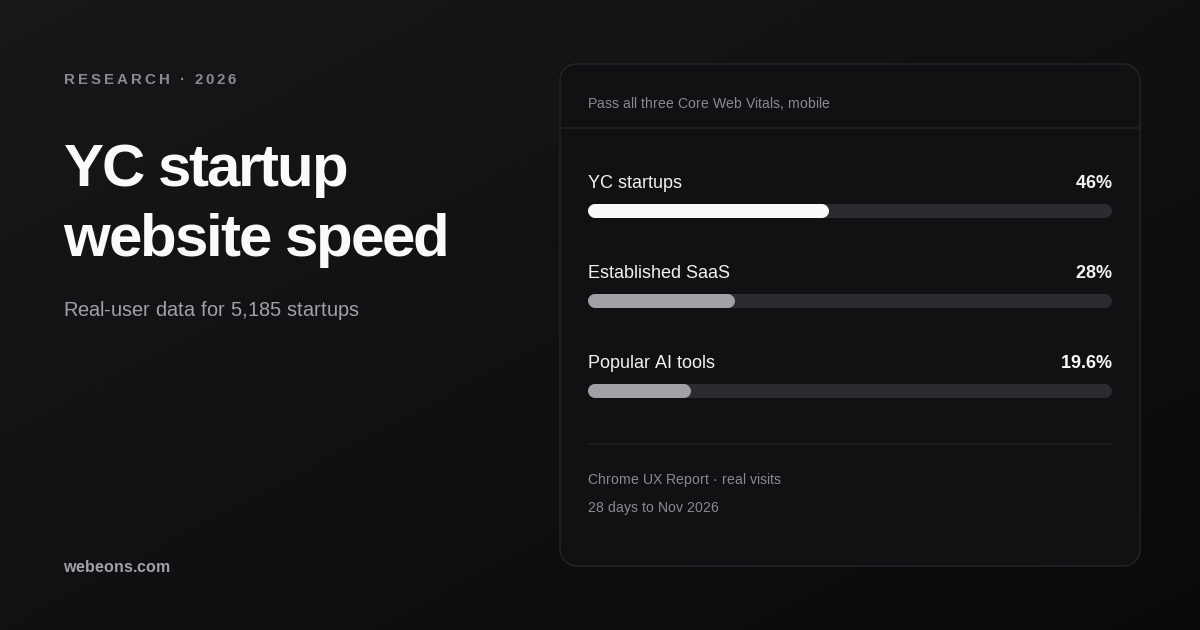
146% of Y Combinator startups pass all three Core Web Vitals on mobile (1,288 measured), from real Chrome users in November 2026. That is far ahead of established SaaS companies (28%) and popular AI tools (19.6%).
2Speed fades as startups grow: 52% of companies with 11 to 50 staff pass on mobile, against 39% at 51 to 200 and 33% at 201 to 1,000. YC's own list of top companies passes at 36%.
3The newest startups are the fastest: 53% of companies from the 2024 to 2026 batches pass, against 41% from 2019 to 2023.
Companies
5,185 YC startups
Measured
1,592 with data
Source
Chrome UX Report
Window
28 days to Nov 2026
Y Combinator has funded more than 6,000 companies, and most of them start the same way: a small team, a landing page and a product built in weeks. We wanted to know whether those websites hold up for real visitors, and what happens to them as a company grows. So we took every active, acquired and public YC company with a website, 5,185 in all, and pulled real-user speed data for each from Google's Chrome UX Report. YC startups turn out to be much faster than the wider software industry. But the advantage shrinks with every hiring round.
Want the full data for all 5,185 companies, with every metric on mobile and desktop? Email hello@webeons.com and we will send it. If you cite this study, please link to this page.
How Fast Are YC Startup Websites? The Headline Numbers
The headline
46%
of Y Combinator startups pass all three Core Web Vitals on a phone. On a computer, 76.7% do.
Real Chrome users · 28 days to about 23 Nov 2026 · 1,288 measured on mobile, 1,838 on desktop
Phone46%
Computer76.7%
Each square is 1% of sites. Filled squares pass.
Core Web Vitals are Google's three measures of how a page feels: how fast the main content appears (Largest Contentful Paint, LCP), how fast the page reacts to a tap or click (Interaction to Next Paint, INP), and whether the layout jumps around (Cumulative Layout Shift, CLS). A site passes when at least 75% of its real visits are rated good on all three: LCP within 2.5 seconds, INP within 200 milliseconds and CLS of 0.1 or less.
For context, the 2025 Web Almanac reports that 48% of all mobile websites pass. YC startups sit right around that line, which is a good result for software companies: in our earlier studies only 28% of established SaaS companies and 19.6% of popular AI tools passed on mobile. Even so, the gap between devices is large. Of the 1,281 startups we could measure on both, 414 pass on a computer and fail on a phone.
Compared
Websites passing Core Web Vitals on a phone, November 2026
Y Combinator startups (1288)46%
Established SaaS companies (1667)28.1%
Popular AI tools (301)19.6%
All three groups measured with the same method and the same month of Chrome UX Report data. Numbers in brackets are sites with mobile data.
Startups Get Slower as They Grow
The clearest pattern in the data is size. Small teams ship small sites. As a company hires a marketing team, it adds what marketing teams add: video, chat widgets, personalisation, consent tools, A/B tests and several analytics tags. Each makes sense on its own. Together they push the site past Google's limits on a phone.
Team size
YC startups passing on a phone, by team size
1–10 staff (514)46.5%
11–50 (391)52.4%
51–200 (249)38.6%
201–1,000 (81)33.3%
Team size as listed in YC's public company directory. Companies with more than 1,000 staff are too few to report on their own.
The same holds at the top. YC marks a few dozen of its biggest successes as top companies, and only 36% of the 39 we could measure pass on mobile, against 46% for every other YC company. Success brings traffic, and traffic brings a bigger website.
YC top companies
Passing on a phone: YC's top companies vs the rest
All other YC companies (1249)46.4%
YC top companies (39)35.9%
Top companies as flagged in YC's public directory. A small group, so read it as an indication.
The Newest Startups Are the Fastest
Companies from the 2024 to 2026 batches pass most often. They are young and small, and many built their sites in the last year or two on modern frameworks and site builders that do a lot of performance work by default. The weakest cohort is 2019 to 2023: companies that raised and hired in the boom years and now carry several years of added tooling on their sites.
YC batch
YC startups passing on a phone, by batch year
2024–2026 batches (389)53.2%
2019–2023 batches (612)41.3%
2005–2018 batches (287)46.3%
Batch year from YC's public directory. Active, acquired and public companies only.
What's Failing: Loading First, Then Responsiveness
Three measures
Share of sites rated good on each measure, on a phone
Weakest
63%
Loading
LCP · main content within 2.5 s
65%
Response to taps
INP · reacts within 200 ms
92%
Layout stability
CLS · nothing jumps (≤ 0.1)
A site must be good on all three to pass. The weakest measure is marked.
Of the 695 startups that fail on mobile, 492 load their main content too slowly and 457 react to taps too slowly; only 112 have a layout shift problem. For 170 of them, responsiveness is the only thing standing between them and a pass. The median startup takes 786 milliseconds before the first byte reaches a phone, a third of the 2.5-second loading budget gone before anything is drawn.
Distribution
How long YC startup websites take to show their main content, on a phone
1,288 sites · each bar is a 25 ms slice · median 170 ms
Interaction to Next Paint at the 75th percentile of real mobile visits, one bar per 25 ms. Everything right of the first dashed line misses Google's 200 ms limit.
Which Kinds of Startups Are Fastest?
Healthcare and industrial startups do best, at 63% and 61% on mobile. Their sites tend to be simple: a clear claim, a few pages and a contact form, because they sell to hospitals, insurers and factories rather than to visitors who sign up on the spot. Education startups do worst at 30%, and consumer startups have the weakest desktop score of any group, because their homepages are often the product itself, with feeds, media and sign-in flows.
By category
YC startups passing Core Web Vitals, phone vs computer, by industry
Phone Computer The gap
Healthcare (106)
63.2% / 83.6%
Industrials (59)
61% / 78.1%
Real estate & construction (30)
53.3% / 84.1%
Consumer (217)
47.5% / 60.8%
Fintech (172)
43.6% / 75.6%
B2B software (647)
42.5% / 79.1%
Education (47)
29.8% / 68.6%
0%50%100%
Industry as listed in YC's public directory. Number of startups with mobile data in brackets.
One result surprised us. AI startups and non-AI startups pass at almost exactly the same rate (45% and 46%). In our study of 500 popular AI tools, only 19.6% passed. The difference is not AI. It is what popular AI products put on their homepages once they have millions of visitors: live demos, prompt boxes and heavy media.
Where Visitors Are Matters
Speed data comes from real visitors, so it reflects their phones and networks as well as the website. Startups headquartered in Europe and North America pass most often. Those serving Latin America, Asia-Pacific, the Middle East and Africa score lower, largely because many of their visitors use lower-end phones on slower connections. That is not a verdict on the engineering. It is a reason for those teams to budget even more carefully.
Region
YC startups passing on a phone, by headquarters region
Europe (130)53.8%
United States & Canada (894)48.9%
Asia-Pacific (113)36.3%
Latin America (71)32.4%
Middle East & Africa (43)14%
Region from each company's listed headquarters. The Middle East & Africa group is small (43), so read it as an indication.
The 20 Fastest YC Startup Websites on Mobile
These 20 pass all three Core Web Vitals on a phone and show their main content in under a second for most visitors. They span batches from 2016 to 2026, which shows that a fast site is a choice, not an accident of age.
Leaderboard
Fastest YC startup websites on a phone, November 2026
Bar length is loading time against Google's 2.5 s "good" limit.
Ranked by how fast the main content appears on a phone (LCP, 75th percentile of real visits). All 20 pass all three Core Web Vitals on mobile. Check any of them yourself with the tool below.
What Founders Can Do
Set a speed budget before the first marketing hire. Agree a limit for page weight and third-party scripts while the site is still small. It is far easier to hold a line than to win it back.
Make every new tag earn its place. Chat widgets, session recorders, A/B tools and duplicate analytics are the usual reasons a fast site gets slow. Load them after the page is interactive, and remove what nobody reads.
Serve the marketing site statically. A near 800 ms time to first byte is common in our sample. A homepage that is the same for everyone should come from the edge, not from a server round trip.
Keep the product off the homepage. Interactive demos and feeds belong one click in, or should load only when someone scrolls to them.
Check the phone numbers every month. PageSpeed Insights and Search Console show the same real-user data used here. Three in four YC startups pass on desktop, so a laptop test will hide the problem.
Which companies. Every Y Combinator company in YC's public directory marked active, acquired or public, with its own website: 5,185 companies after removing duplicates and sites hosted on shared platforms (such as Notion pages or app store links). Inactive companies are excluded. Company details (batch, industry, team size, headquarters, top-company flag) come from the directory via the open yc-oss dataset.
Which data. Google's Chrome UX Report (CrUX) API: how real Chrome users experienced each website over the previous 28 days, on phones and on desktop, queried on 23 November 2026. We used origin-level data, which covers all pages on the domain.
Who is measured. 1,592 startups had enough Chrome traffic for CrUX to publish mobile data, and 1,288 of those have data for all three measures. Startups without data are not counted in any percentage. This means the study describes YC startups that have real traffic, not every YC company.
Pass rule. Google's own: LCP ≤ 2.5 s, INP ≤ 200 ms and CLS ≤ 0.1 at the 75th percentile.
Limits. Team size and industry are as companies list them in YC's directory, and may be out of date. The AI group is companies tagged with AI-related tags in the directory. Comparisons with our SaaS and AI tools studies use the same method and month, but the groups overlap slightly. The full list of measured companies is below.
Every startup in this study1,592 names, grouped by category. Scores are kept with us; ask for them by email.+
Written by the team that builds AskOrac, BlurbBio and The Bookish Elf. We design and build digital products, and we write about what we learn doing it. Facts checked against the sources listed, reviewed November 23, 2026.
Need help with this?
We build exactly what this article describes: production software for ambitious companies.