Which Website Builder Is Fastest? Real-User Core Web Vitals for 4.4 Million Sites
Wix, Shopify, Squarespace, Webflow and Framer now beat WordPress on real-user speed, but the lead vanishes for busy sites. Chrome UX Report data for 40+ platforms, with a 3-year trend.
"Which website builder is fastest?" is one of the most common questions a small business asks, and most answers are based on a handful of lab tests of demo sites. We wanted the answer from real visitors. So we took the Chrome UX Report data that HTTP Archive publishes for every platform it can detect, covering about 4.4 million websites on more than 40 builders, content management systems, shops and frameworks, and asked one question: what share of each platform's sites pass Google's Core Web Vitals on a phone?
The answer has changed a lot in three years. Hosted builders, often criticised as slow a few years ago, now lead, and WordPress, which runs most of the web, sits below half. But the picture flips for the busiest sites, and some of the most fashionable developer frameworks do worst of all.
Want the full table for every platform, country and traffic tier? Email hello@webeons.com and we will send it. If you cite this study, please link to this page.
Which Website Builder Is Fastest? The Headline Numbers
Core Web Vitals are Google's three measures of how a page feels to a real visitor: how fast the main content appears (Largest Contentful Paint, LCP), how fast the page reacts to a tap (Interaction to Next Paint, INP), and whether the layout jumps around (Cumulative Layout Shift, CLS). A site passes when at least 75% of real visits are good on all three: LCP within 2.5 seconds, INP within 200 milliseconds and CLS of 0.1 or less. These are the same numbers Google shows in Search Console and PageSpeed Insights.
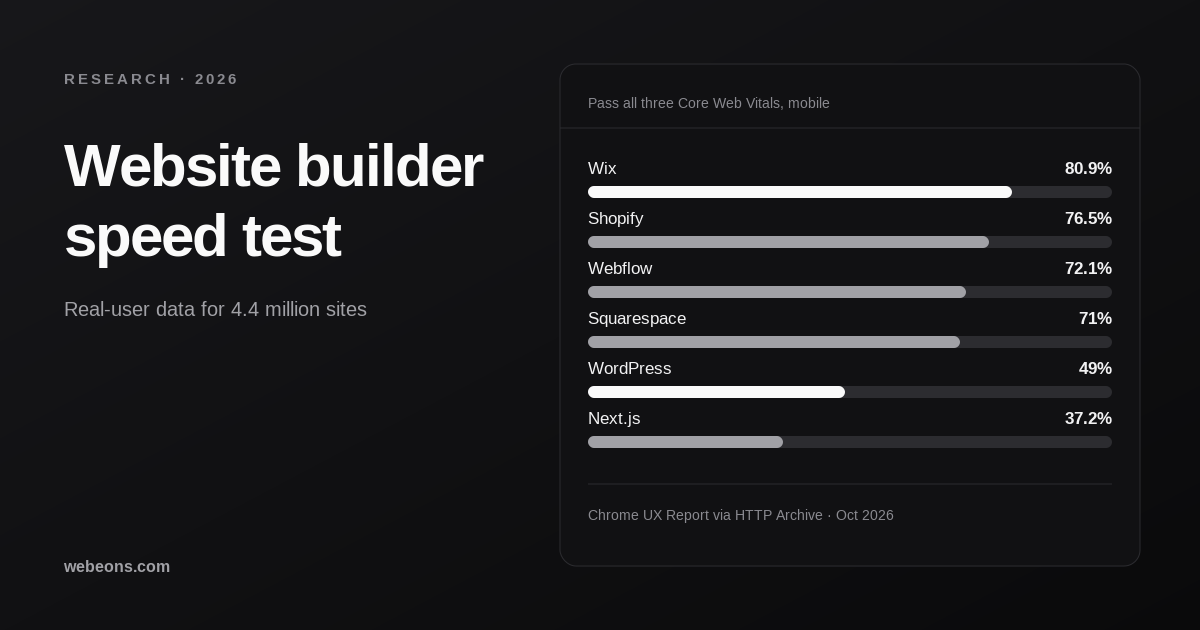
Duda (86%), Wix (81%) and Shopify (77%) lead the big platforms on phones. Webflow, Framer and Squarespace are close together at 71 to 72%. WordPress passes 49% of the time and Next.js 37%. On a computer every platform does better, but the order barely changes.
Website Builders Ranked
Among the hosted builders, the smaller European player Jimdo has the highest pass rate of any platform in the data (94%), followed by Duda, GoDaddy's builder and Wix. At the other end, Weebly (42%), Strikingly (24%) and Weblium (23%) have fallen well behind. Hostinger's builder is the surprise: 83% of its sites pass on a computer but only 50% on a phone.
Content Management Systems Ranked
Traditional CMSs split in two. TYPO3, Umbraco, Ghost and Drupal sites pass most of the time, partly because they are usually built and hosted by agencies for organisations with an IT budget. WordPress sits at 49%, and the big enterprise platforms, Sitecore (40%) and Adobe Experience Manager (35%), do worse than WordPress despite their price. Blogger is last at 26%.
E-commerce Platforms Ranked
Hosted shops pass far more often than self-hosted ones. Wix stores (79%) and Shopify (77%) lead; WooCommerce, which runs on WordPress, passes 41% of the time and Magento 47%. With a hosted shop, the platform runs the servers, the image resizing and the content delivery network. With WooCommerce or Magento, the store owner does, and most do it on budget hosting.
Frameworks: Static Sites Win, App Frameworks Lag
Developer frameworks show the widest spread of all. Static site generators, which send finished HTML and little JavaScript, pass most often: Hugo 79%, Jekyll 78% and Astro 72%. Frameworks built for web apps do worst: Next.js 37%, Remix 33% and Nuxt 28%. Their weak point is responsiveness. Only 60% of Next.js sites have a good INP on mobile, against 90% of WordPress sites, because they send and run a lot of JavaScript in the visitor's browser.
We build with Next.js ourselves, so this is not a comfortable number for us. But it matches what we see in audits: the framework does not make a site fast or slow. The choices do. A Next.js marketing site that is rendered ahead of time, served from the edge and kept light on client-side JavaScript passes easily; a Next.js site that ships the whole app to every visitor does not. Many of the 414,664 Next.js sites in this data are web apps, not brochure sites.
Three Years of Change: How Wix Overtook WordPress
In October 2023, 56% of Wix sites passed on mobile. Three years later it is 81%, a rise of 25 points, the biggest gain of any major platform. Squarespace climbed 24 points and Webflow 19. WordPress improved too, from 36% to 49%, but it started lower and gained less. Next.js moved least: from 30% to 37%.
Show the numbers
| Platform | Oct 2023 | Oct 2026 |
|---|---|---|
| Wix | 56.3% | 80.9% |
| Squarespace | 46.8% | 71% |
| Webflow | 53.4% | 72.1% |
| Shopify | 62.2% | 76.5% |
| WordPress | 36.3% | 49% |
| Next.js | 29.7% | 37.2% |
Why WordPress Fails: It Is the Server
WordPress sites do well on responsiveness (90% have a good INP) and layout stability (88%). Where they fail is loading. Only 56% have a good LCP, and the reason starts on the server: just 24% of WordPress sites send their first byte to a phone in under 800 milliseconds, Google's threshold for a good time to first byte. Shopify manages it for 85% of stores and Wix for 79% of sites.
Hosted builders run every site on the same tuned infrastructure, with caching and a global content delivery network included. A WordPress site is only as fast as the hosting its owner picked, and most sites are on cheap shared hosting with no page cache.
Page builders make it worse. Sites built with Elementor, the most-used WordPress page builder, pass 37% of the time, and Divi sites 42%, against 49% for WordPress overall. Beaver Builder, which outputs leaner pages, does better than average at 54%.
The Twist: Busy Sites Tell a Different Story
The builders' lead comes from millions of small sites: a café, a portfolio, a consultant's five pages. When we look only at the busiest websites, it disappears. Among the top 1 million sites by traffic, Wix (52%), Webflow (51%) and WordPress (51%) pass at almost the same rate. Among the top 100,000, WordPress passes 54.2% of the time, ahead of Shopify (38.4%), Webflow (31%) and Next.js (25.6%).
Busy sites carry more of everything: tracking, personalisation, chat, video, consent tools and experiments. On a builder, the team cannot change the hosting or how pages are rendered to make room for it. On WordPress or a custom build, a team with a budget can, and the big WordPress sites mostly do.
Where Visitors Are Matters
Real-user data reflects visitors' phones and networks as well as the website. In the US, UK, Germany and Canada, around nine in ten Wix sites and two in three WordPress sites pass. In India and Brazil, where many visitors use lower-end phones on slower connections, pass rates fall for every platform: 56% for Wix and 31% for WordPress in India. Squarespace drops to 9% in India. Whatever you build on, test on the kind of phone your customers use.
Don't Trust a Lighthouse Score Alone
Many "fastest builder" comparisons use Lighthouse, Google's lab test. The real-user data shows why that misleads. The median Squarespace homepage scores 31 out of 100 in Lighthouse on mobile, yet 71% of Squarespace sites pass with real visitors. Blogger scores 70 in the lab and passes 26% of the time in the field. A lab test runs one page load on a simulated slow phone; the Chrome UX Report counts every real visit for 28 days. When the two disagree, the field data is what Google uses.
What This Means If You're Choosing a Platform
- For a small site, a good hosted builder is the safe choice on speed. Duda, Wix, Webflow, Framer, Squarespace and Shopify give most owners a passing site without any tuning.
- On WordPress, fix hosting first. A page cache and a host with fast server response will do more than any theme change. Then think twice about heavy page builders.
- Don't pick a framework for speed alone. Static-first tools pass most often. With Next.js, Nuxt or Remix, pre-render marketing pages and keep client-side JavaScript small, or you will land in the 63% that fail.
- Growing sites need control. Once a site carries a marketing stack, the platform that lets you tune hosting and rendering wins, which is why big WordPress and custom sites overtake builders at the top.
- Measure with real users, on phones. PageSpeed Insights and Search Console show the field data used here. A laptop test or a single Lighthouse run will flatter or punish you for the wrong reasons.
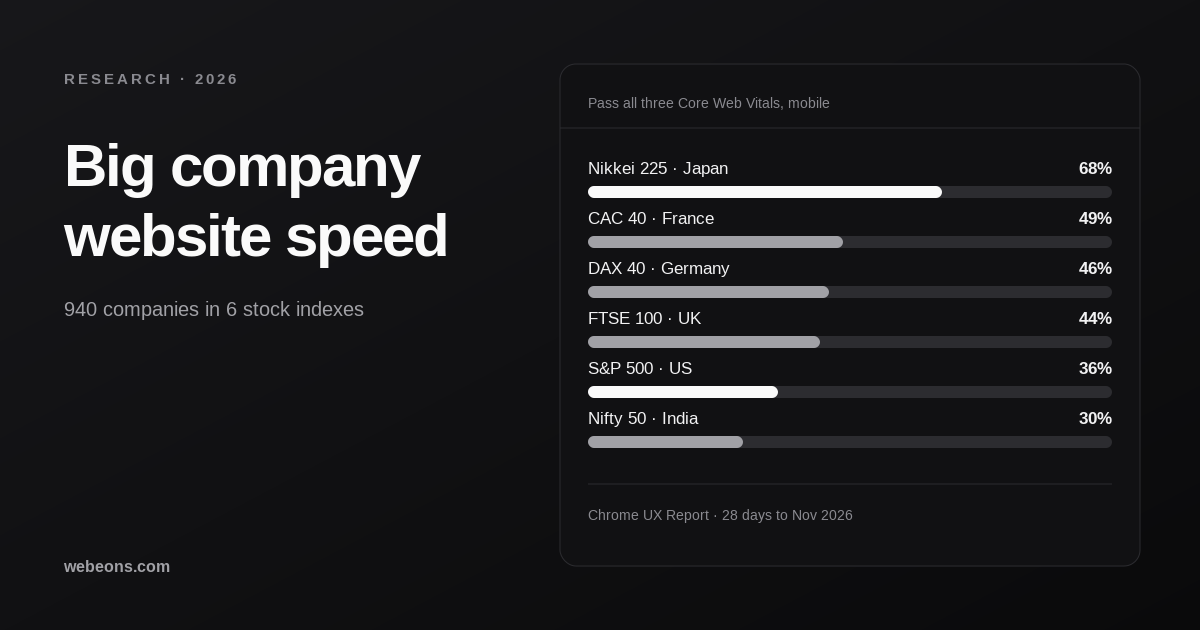
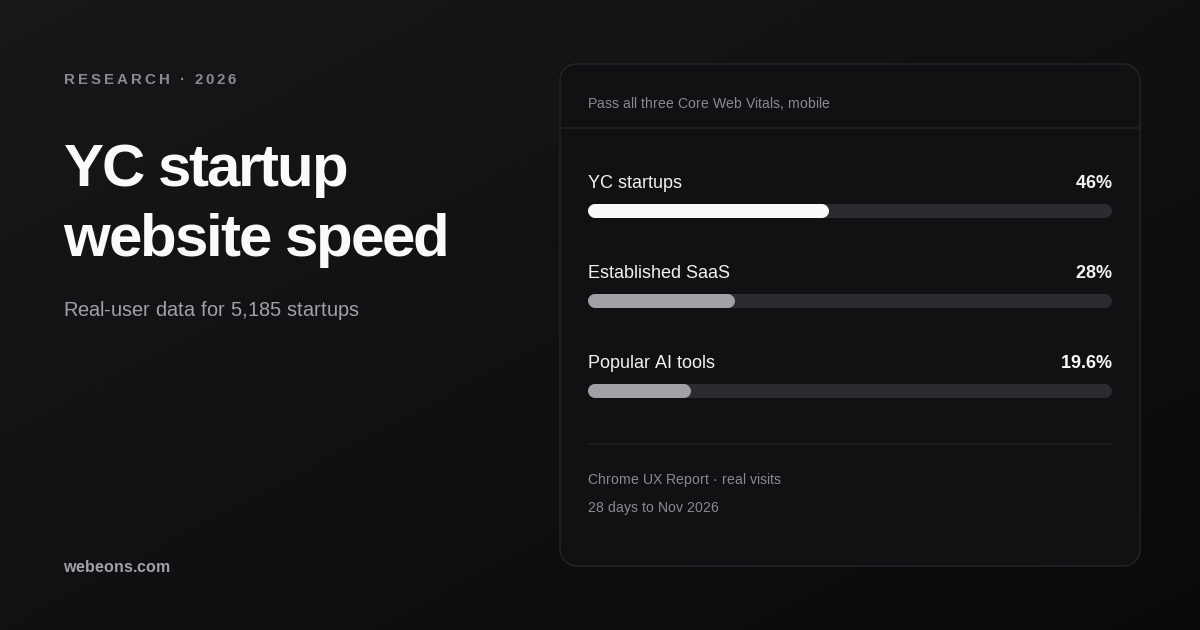
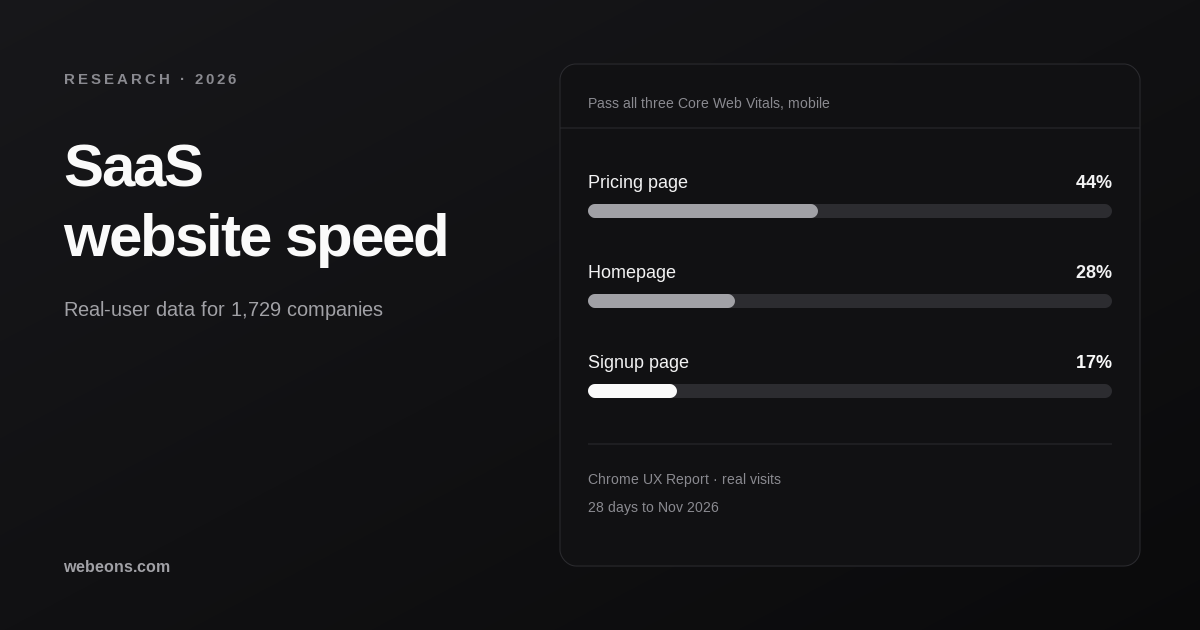
Want to know where your own site stands? Our free SEO audit runs real PageSpeed tests and ranks what to fix first. For more research, see our studies of 5,185 Y Combinator startups, 1,729 SaaS companies and 500 AI tools, all in our research section.
Method
- Which data. Google's Chrome UX Report (CrUX), which records how real Chrome users experience websites, as aggregated by platform in the HTTP Archive Technology Report. We used the October 2026 dataset (the latest available on 23 November 2026), plus every monthly dataset since October 2023 for the trend.
- How platforms are detected. HTTP Archive crawls the home page of every website in CrUX and detects the technology it uses with Wappalyzer, an open-source detection library. A site counts for a platform when that platform is detected on its home page. A few sites are detected under two platforms (for example WordPress and Next.js); the overlap is small.
- Who is measured. Only websites with enough Chrome traffic for CrUX to publish data: about 4.4 million websites across the platforms in this study. Very small or new sites without enough visits are not included on any platform.
- Pass rule. Google's own: LCP ≤ 2.5 s, INP ≤ 200 ms and CLS ≤ 0.1 at the 75th percentile of visits, measured for the whole website (origin). Time to first byte is good at 800 ms or less.
- Limits. This compares the sites people build on each platform, not the platforms under identical conditions. Platforms differ in who uses them and for what, so a platform with many simple sites has an advantage. That is why we also break the data down by traffic rank and country.
We plan to re-run this study every six months. Run a platform we should add? Email hello@webeons.com.
Sources (7)
Need help with this?
We build exactly what this article describes: production software for ambitious companies.