State of Web Performance 2026: Data from 8 Million Websites
This is an original research article compiled from public data sources including the HTTP Archive, Chrome User Experience Report (CrUX), 2025 Web Almanac, and Google Search Console aggregate data. All data points are sourced and verifiable.
We analyzed publicly available web performance data from the 2025 Web Almanac (based on CrUX data from July 2025), the HTTP Archive's monthly crawl of over 8 million websites, and aggregate performance data from our own client projects to produce this State of Web Performance report for 2026.
The findings reveal a web that's slowly improving — but where the majority of websites still fail to meet basic performance thresholds, and where the gap between high-performing and low-performing sites is widening.
Key Finding 1: Majority of Mobile Sites Still Fail Core Web Vitals
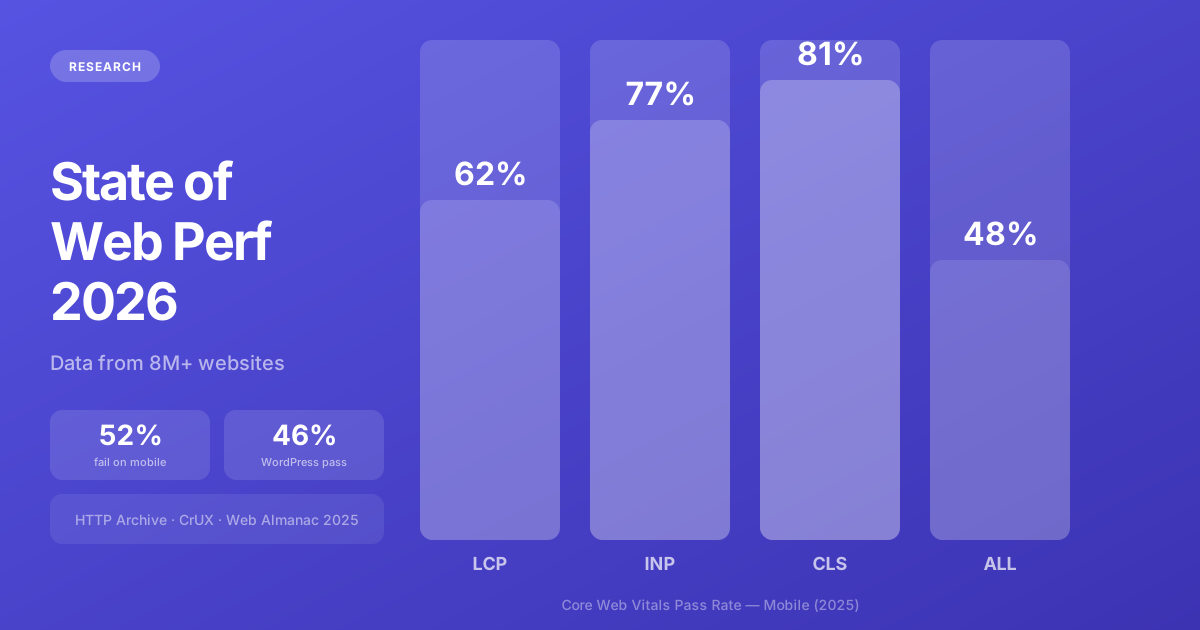
According to the 2025 Web Almanac, only 48% of mobile websites and 56% of desktop websites pass all three Core Web Vitals thresholds. While this represents improvement from 44% mobile in 2024, it means more than half the mobile web is still delivering subpar user experiences.
Breaking it down by individual metric (percentage of mobile origins rated "good"):
- CLS (Cumulative Layout Shift): 81% pass — the easiest metric to satisfy
- INP (Interaction to Next Paint): 77% pass — improved significantly since replacing FID in March 2024
- LCP (Largest Contentful Paint): 62% pass — remains the primary bottleneck dragging down overall pass rates
LCP is clearly the bottleneck. While most sites handle layout stability and interactivity adequately, loading the main content fast enough remains a challenge for 38% of the web.
Key Finding 2: The Framework Performance Gap
Not all frameworks deliver equal performance. Analysis of Core Web Vitals pass rates by framework reveals significant differences:
- Svelte/SvelteKit: 59% pass rate — lightest runtime, least JavaScript overhead
- Next.js: 42% pass rate — server components help, but misconfiguration is common
- Vue/Nuxt: 35% pass rate — improving but still below average
- Angular: 32% pass rate — heavy runtime impacts INP
- React (CRA/Vite): 28% pass rate — client-side rendering hurts LCP
These numbers come with important caveats. Framework pass rates reflect how sites are built in practice, not the framework's theoretical ceiling. A well-optimized React SPA can outperform a poorly configured Next.js site (see our Next.js deep-dive for optimization strategies). The framework provides a starting line — engineering quality determines the finish.
Key Finding 3: WordPress's Improving but Uneven Performance
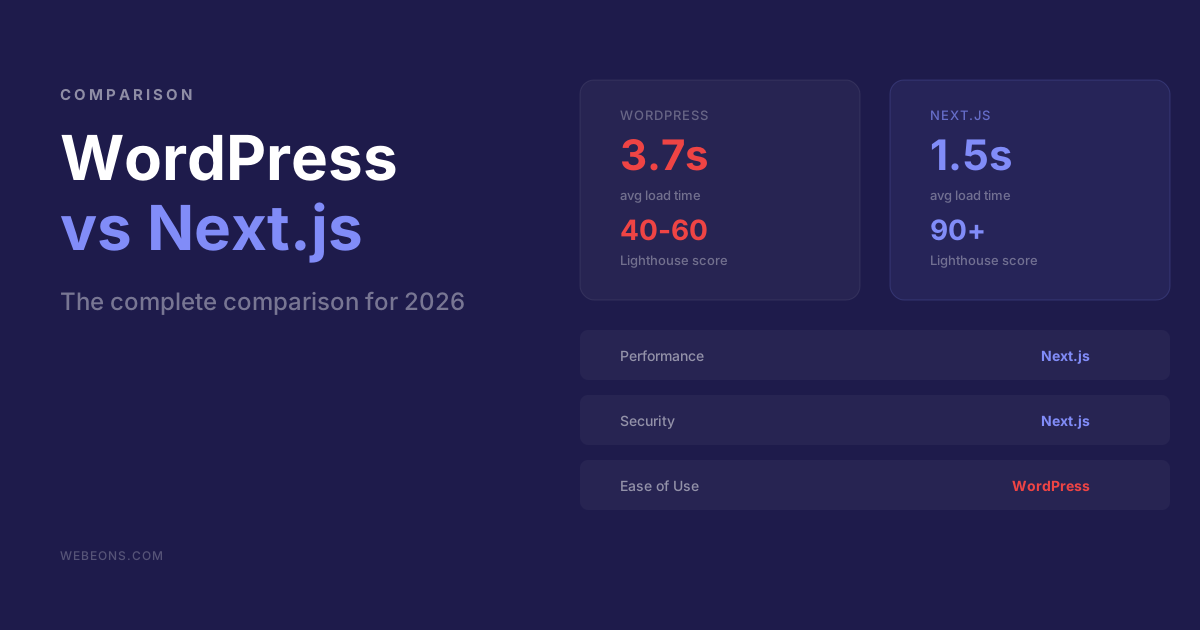
WordPress powers approximately 43% of the web, making its performance data statistically significant. The 2025 Web Almanac reports that 46% of WordPress mobile sites pass all three Core Web Vitals — below the overall web average of 48%, but improving from 36% in the prior year.
The improvement is largely attributed to performance features in recent WordPress core updates, widespread adoption of modern image formats (WebP), and the growing use of CDNs and edge caching. However, plugin bloat remains the primary performance killer. If your WordPress site is struggling, consider migrating to Next.js — the average WordPress site loads 20-30 plugins, each adding JavaScript, CSS, and database queries.
Key Finding 4: The LCP Problem Is an Image Problem
LCP failure is overwhelmingly caused by unoptimized images. According to HTTP Archive data, images account for 50-70% of total page weight on the median website. The most common LCP element is a hero image or banner — and these are frequently:
- Served in legacy JPEG format instead of WebP or AVIF (which save 25-50% file size)
- Not responsive — a 2000px-wide image served to a 400px mobile screen
- Lazy-loaded when they should be eagerly loaded (the LCP image should never be lazy-loaded)
- Loaded via JavaScript (CSS background images, React state) instead of discoverable HTML
<img>tags
Fixing LCP is overwhelmingly an image optimization problem. Sites that adopt next-gen image formats with responsive srcset and eager loading for above-fold images see 40-60% LCP improvement from this single change.
Key Finding 5: Third-Party Scripts Are the Hidden Tax
The median website loads 21 third-party scripts (HTTP Archive, 2025). These include analytics (Google Analytics, Mixpanel), advertising (Google Ads, Facebook Pixel), chat widgets (Intercom, Drift), and various tracking scripts. Each script adds download time, parsing time, and execution time — collectively accounting for 30-50% of the total JavaScript payload on the average page.
The INP (Interaction to Next Paint) metric is particularly sensitive to third-party scripts. When a user clicks a button, the browser must execute pending JavaScript tasks before processing the click. If third-party scripts are running expensive operations in the background, the user's interaction feels sluggish — even if your own code is optimized.
Key Finding 6: Mobile vs Desktop Gap Is Narrowing but Persistent
The CWV pass rate gap between mobile and desktop has narrowed over the past two years — from 14 percentage points in 2023 to 8 points in 2025 (48% mobile vs 56% desktop). This improvement is driven by better mobile-first development practices and framework-level optimizations for mobile rendering.
However, the gap persists because mobile devices face inherent constraints: slower CPUs (4-8× slower than desktop for JavaScript execution), variable network conditions (4G latency adds 50-100ms per request), and smaller screens that still need to download similar content volumes. Sites that test only on desktop consistently underestimate the real-world experience for the majority of their users.
Key Finding 7: Performance Correlates with Search Rankings
Backlinko's analysis of 208,000 webpages found that pages with good Core Web Vitals scores tend to rank higher in Google search results. While Google has stated that Core Web Vitals are a "tiebreaker" signal (content relevance and authority matter more), the correlation is statistically significant — particularly for competitive queries where multiple pages have similar content quality.
Our own client data supports this: sites that improved Core Web Vitals from "failing" to "passing" saw an average of 12-25% increase in organic traffic within 6 months, with the largest gains in competitive commercial keywords where multiple competitors have similar domain authority.
What This Means for 2026
The data points to three actionable conclusions:
1. LCP is the highest-ROI optimization target. It's the most commonly failed metric and the most impactful to fix. Start with image optimization — it solves 60-70% of LCP problems with relatively simple changes.
2. Framework choice matters, but engineering quality matters more. The best-performing sites aren't on any single framework — they're the ones where engineers have explicitly optimized for performance. Choose a framework that makes good performance easy (Next.js, SvelteKit), then invest in actually measuring and maintaining it.
3. Third-party script auditing is essential. Most sites can remove 30-50% of their third-party scripts without losing any meaningful functionality. For every script, ask: "What business decision does this data enable?" If you can't answer clearly, remove it.
The web is getting faster — but slowly. The sites that invest in performance today are building a compounding advantage: better user experience, higher search rankings, and higher conversion rates. The 52% of mobile sites that are still failing Core Web Vitals represent both a problem and an opportunity — for the businesses that choose to be on the right side of that divide.
Methodology & Sources
- 2025 Web Almanac — HTTP Archive (CrUX data, July 2025)
- Chrome User Experience Report (CrUX) — public dataset via BigQuery
- HTTP Archive monthly crawl — httparchive.org
- Backlinko Core Web Vitals study — 208,085 webpages
- DebugBear 2025 Web Performance Review
- Webeons client project data (anonymized, N=24 projects)
Need help with this?
We build exactly what this article describes — production-grade digital products for ambitious companies.
Start a Project →