The AI Tech Stack We Use in 2026: Models, Tools, and Infrastructure
The AI landscape changes monthly. New models, new frameworks, new vector databases, new orchestration tools — the pace of innovation is exhilarating and overwhelming in equal measure. For engineering teams building production AI features, the challenge isn't finding options — it's choosing the right ones and committing to them long enough to ship.
After two years of building production AI features across SaaS products, customer support systems, document processing pipelines, and content generation tools, we've settled on an opinionated stack that balances capability, reliability, cost, and developer experience. This article documents exactly what we use at each layer, why we chose it over alternatives, and what we're watching for 2026 and beyond.
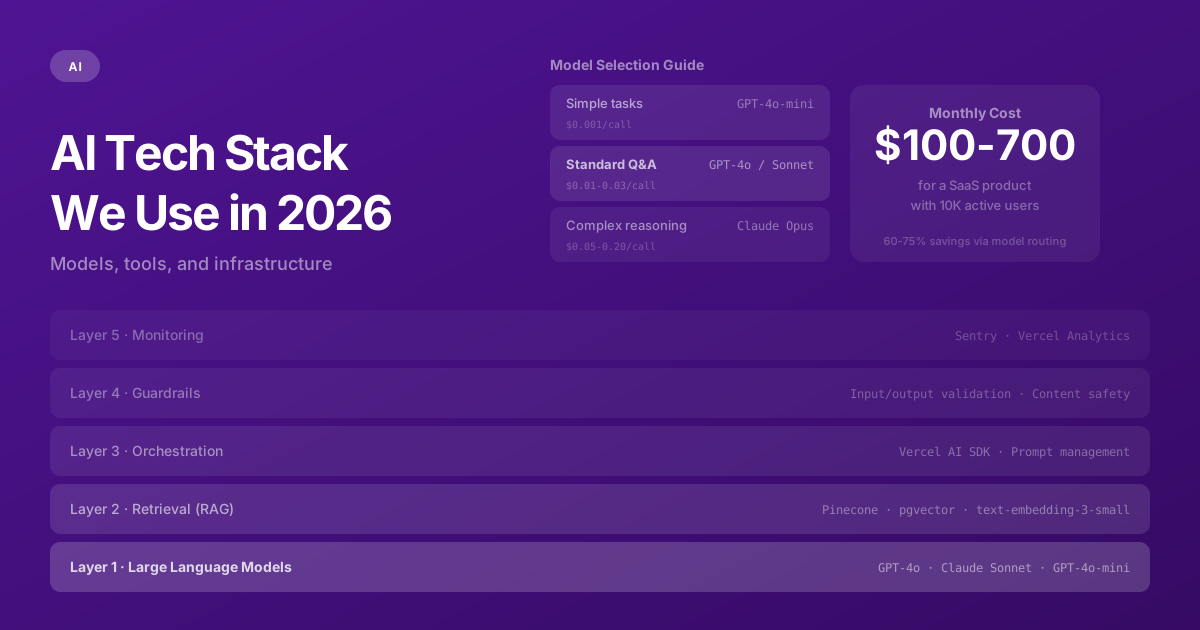
Layer 1: Large Language Models
Model selection is the most visible decision but rarely the most important one. The difference between GPT-4o and Claude Sonnet matters far less than the difference between good and bad retrieval, or between present and absent guardrails. That said, each model has genuine strengths worth understanding.
Primary: OpenAI GPT-4o
GPT-4o is our default for most production tasks. It handles complex reasoning, code generation, structured data extraction, classification, and multi-turn conversations with consistently high quality. The multimodal capabilities — accepting both text and image input in a single request — are particularly valuable for document processing workflows where we need to understand scanned documents, receipts, diagrams, and screenshots alongside text.
GPT-4o's structured output mode (JSON mode with schema enforcement) is excellent for tasks where we need reliable, parseable responses — extracting structured data from unstructured text, generating database-ready JSON, or producing consistent categorizations. The function calling API is mature and handles complex tool orchestration well.
Secondary: Anthropic Claude Sonnet
Claude is our go-to for tasks requiring careful reasoning, long-context processing, nuanced instruction following, and tasks where getting the tone and style right matters. For analyzing lengthy documents (contracts, research papers, codebases), generating structured reports, and any task where precision and thoughtfulness matter more than speed, Claude consistently delivers.
Claude's 200K token context window is a genuine differentiator. While GPT-4o supports 128K tokens, Claude's larger window lets us process entire codebases, full regulatory documents, and comprehensive knowledge bases without chunking — which eliminates an entire class of retrieval-related errors.
Budget Tier: GPT-4o-mini / Claude Haiku
For classification, intent detection, simple Q&A, text formatting, and high-volume tasks where cost matters more than peak quality, smaller models deliver 80-90% of the output quality at 5-10% of the cost. We route queries through an intent classifier that sends simple questions to cheap models and complex ones to premium models.
This routing approach isn't just about cost savings — it also reduces latency. GPT-4o-mini responds in 200-400ms versus 800-1500ms for GPT-4o. For interactive features like autocomplete, inline suggestions, and real-time classification, that latency difference is the difference between feeling instantaneous and feeling sluggish.
Layer 2: Retrieval & Knowledge Management
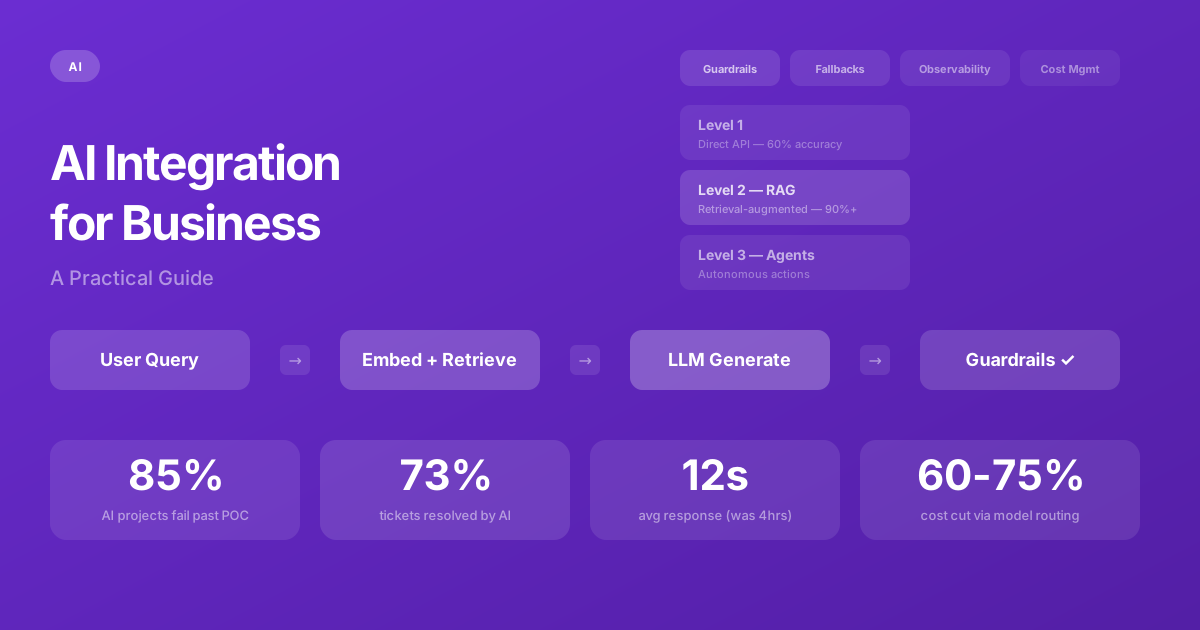
RAG (Retrieval-Augmented Generation) is the most impactful architectural pattern in production AI. We cover the practical implementation side in our AI integration guide. Instead of relying on the model's training data (which is static, potentially outdated, and doesn't include your business-specific information), RAG retrieves relevant context from your own data at query time and includes it in the prompt. The model's job shifts from "know everything" to "reason over the information I'm given" — which it does much more reliably.
Vector Database: Pinecone or pgvector
For production RAG systems, the vector database stores semantic embeddings of your content and retrieves the most relevant chunks for each user query. We use Pinecone for large-scale deployments (millions of vectors, sub-50ms queries, managed infrastructure) and pgvector (a PostgreSQL extension) for smaller projects where adding a separate vector database service isn't justified.
pgvector has improved dramatically in the past year and handles up to ~500K vectors efficiently on a standard PostgreSQL instance. For most early-stage SaaS products, this is more than sufficient — and it means your vectors live in the same database as your application data, simplifying both architecture and operations.
Embeddings: OpenAI text-embedding-3-small
OpenAI's latest embedding model offers the best quality-to-cost ratio we've found. It produces 1536-dimensional vectors that capture semantic meaning with high accuracy. A million tokens of text costs approximately $0.02 to embed — meaning you can process an entire documentation site or knowledge base for pennies.
For most applications, the "small" variant is sufficient. The "large" variant (3072 dimensions) adds marginal quality improvement at 5× the cost and 2× the storage requirement. We only use it for applications where retrieval accuracy is business-critical, like medical or legal document analysis.
Document Processing: LangChain
Raw documents need to be chunked, cleaned, and embedded before they're useful in a RAG pipeline. LangChain provides document loaders for PDFs, web pages, Notion databases, Google Drive, Confluence, and dozens of other sources. Its text splitters handle the nuance of chunking — respecting paragraph boundaries, maintaining context overlap between chunks, handling tables and code blocks, and preserving metadata about where each chunk originated.
We use a recursive character splitter with 500-token chunks and 50-token overlap as our default configuration. The overlap ensures that information at chunk boundaries isn't lost — a sentence that spans two chunks will appear (at least partially) in both, preventing retrieval gaps.
Layer 3: Orchestration & Developer Experience
Framework: Vercel AI SDK
The Vercel AI SDK is the cleanest abstraction we've found for building AI features in Next.js applications. It handles streaming responses (essential for chat interfaces — users see tokens appear in real-time rather than waiting for the complete response), tool calling (letting the AI invoke functions in your application), multi-step conversations with context management, and provider abstraction that makes switching between OpenAI and Anthropic a one-line change.
import { generateText, streamText } from 'ai';
import { openai } from '@ai-sdk/openai';
import { anthropic } from '@ai-sdk/anthropic';

// Streaming chat with tool calling
const result = await streamText({
  model: openai('gpt-4o'),  // Switch to anthropic('claude-sonnet-4-20250514') in one line
  system: 'You are a helpful customer support agent for Acme Corp.',
  messages: conversationHistory,
  tools: {
    lookupOrder: {
      description: 'Look up order details by order ID',
      parameters: z.object({ orderId: z.string() }),
      execute: async ({ orderId }) => db.order.findUnique({ where: { id: orderId } }),
    },
    createTicket: {
      description: 'Create a support ticket for issues requiring human review',
      parameters: z.object({ subject: z.string(), priority: z.enum(['low', 'medium', 'high']) }),
      execute: async ({ subject, priority }) => supportSystem.createTicket({ subject, priority }),
    },
  },
});
Prompt Management: Code, Not Databases
We store prompts in TypeScript files alongside the code that uses them — not in a database, not in a third-party prompt management tool, not in a shared Google Doc. Prompts are code: they need version control (who changed what, when, and why), code review (another engineer validates the change), type safety (TypeScript ensures prompt variables are correctly typed), and automated testing (evaluation suites run against prompt changes before deployment).
When a prompt changes, we can trace the exact commit, see the diff, read the code review comments, and check the evaluation results — the same engineering discipline we apply to every other piece of production code.
Layer 4: Guardrails & Safety
Input Validation
Every user message passes through a lightweight classifier before reaching the LLM. This classifier — running on GPT-4o-mini for speed and cost — detects prompt injection attempts ("ignore your instructions and..."), off-topic queries that would waste expensive model calls, requests for information the AI shouldn't provide, and messages in languages the system isn't designed to handle. This layer adds less than 100ms of latency and costs less than $0.001 per classification.
Output Validation
AI responses pass through a validation layer before reaching users. This layer checks for competitor mentions, unauthorized promises or guarantees, confidential information leakage, responses that contradict documented company policies, and content that's off-brand in tone or style. Most of these checks are simple pattern matching or keyword detection — fast, cheap, and highly effective at catching the most common failure modes.
Layer 5: Monitoring, Evaluation & Cost
Observability
Every AI interaction is logged with full context: input message, retrieved chunks and their relevance scores, complete prompt sent to the model, model response, end-to-end latency broken down by step (embedding, retrieval, inference, validation), token usage and computed cost, and user feedback signals. We build custom dashboards that track accuracy trends, average response times, cost per query, most common unanswered questions, and hallucination frequency over time.
Automated Evaluation
We maintain test suites of 100-500 question-answer pairs for each AI feature. These are curated from real user queries and their verified correct answers. The suites run nightly against production prompts and flag regressions in accuracy, relevance, and hallucination rate. When a new model version is released, we evaluate it against this entire test suite before upgrading — and we never upgrade blindly just because a model is "newer."
Cost Reality: What AI Features Actually Cost to Run
One of the most common surprises for businesses integrating AI is the ongoing operational cost. Unlike traditional features that cost nothing per use after deployment, AI features have a per-request cost that scales with usage. Here's what real production costs look like:
- Simple chatbot (GPT-4o-mini): ~$0.001-0.003 per conversation turn. At 10,000 conversations per month: $10-30/month.
- RAG-powered support bot (GPT-4o): ~$0.01-0.05 per query including embedding and retrieval. At 10,000 queries per month: $100-500/month.
- Document analysis (Claude Sonnet, long context): ~$0.05-0.20 per document depending on length. Processing 1,000 documents per month: $50-200/month.
- Vector database (Pinecone Starter): $70/month for managed infrastructure handling most small-to-medium applications.
The key insight: AI infrastructure costs are predictable and manageable when you design for them from the start. The expensive mistake is building every feature with premium models, then discovering the bill when usage scales. Intelligent model routing reduces costs by 60-75% with minimal quality impact.
What We're Watching for Late 2026
The AI stack evolves fast. Developments we're monitoring and evaluating for production adoption:
- Smaller, faster models running on the edge — Models like Phi-3 and Gemma that can run on CDN edge nodes without API calls. This eliminates latency entirely for simple tasks and removes per-request API costs.
- Multimodal models with audio and video — GPT-4o already handles images; native audio and video processing will unlock new application categories (meeting summarization, video content analysis, voice interfaces).
- Improved fine-tuning accessibility — Fine-tuning lets you customize model behavior for your specific domain without complex prompt engineering. As tools improve and costs decrease, this becomes viable for more use cases.
- Agent frameworks maturing — Tools like LangGraph and CrewAI are making multi-step agent workflows more reliable. We're cautiously optimistic but currently use custom orchestration for production agent systems.
The fundamentals — retrieval architecture, guardrails, evaluation pipelines, cost management — will remain essential regardless of which models or frameworks win. Invest in the infrastructure layer, and you can swap models as the landscape evolves without rebuilding your entire AI stack.
Need help with this?
We build exactly what this article describes — production-grade digital products for ambitious companies.
Start a Project →